Your guest services team answers the same directional questions hundreds of times per game:
- Fans struggle with unusable PDF maps on their phones.
- Sponsors pay for static logo placements with zero engagement data.
- When a concession stand closes unexpectedly, your maps stay wrong until the next expensive reprint.
These operational inefficiencies are costing your venue real money while competitors deliver modern digital experiences that generate sponsorship revenue and measurable fan satisfaction improvements.
The sports and entertainment industry has reached a tipping point. With 82% of sports fans using their mobile phones in some way while at a live professional sporting event, the gap between traditional, 2D map-based wayfinding and what fans expect in a digital stadium experience has never been wider.
A single guest services representative might spend 10+ minutes per directional question during peak entry times. Multiplied across your entire staff, that's thousands of dollars in operational inefficiency per game.
This guide examines what actually matters when evaluating fan experience software:
- Mobile-optimized wayfinding that works
- Self-service map updates your operations team controls
- Revenue-generating sponsorship tools
- Actionable fan engagement analytics
We'll compare digital, interactive mapping platforms like Mappedin against traditional approaches as well as alternative solutions like PAM and Concept3D.
Looking for a solution to power in-stadium fan engagement, promote gameday offers, simplify operations, and improve fan experience analytics? Book a custom demo of Mappedin →
What modern fans expect in your stadium
St. Louis City SC surveyed their fans before, during, and after match days. Their interactive stadium map maintained an 84% satisfaction rate and became the second most-used feature in their official app.
Meanwhile, venues still relying on static PDF maps see the opposite:
- Frustrated fans
- Overwhelmed guest services teams
- No measurable engagement data
This exposes a massive gap between what fans expect and what traditional wayfinding delivers. Using a PDF map on your phone in a crowded stadium on game day poses serious usability issues that impact a fan’s likelihood to return to the stadium for future events:
- Can't zoom to specific concourses
- Need to pinch and scroll endlessly to find their section
- Can’t search for the nearest restroom or find food options before kickoff
That's the experience millions of fans endure at venues that haven't modernized.
4 failures of outdated stadium wayfinding and fan experience
1. Your guest services staff becomes the navigation system
Staff members spend 10+ minutes per question explaining complex multi-floor escalator routes or directing fans around club areas. Multiply that by hundreds of questions per game, and you're looking at significant staff time diverted from actual guest experience priorities where they add real value.
2. Lost sponsorship revenue adds up
Traditional static placements on paper maps generate minimal revenue and provide sponsors with no engagement data. They pay based on circulation estimates, but you can't prove anyone noticed their placement, much less acted on it.
Meanwhile, digital branded locations command premium pricing because sponsors get searchable, discoverable placements with concrete engagement metrics.
3. No flexibility when things change
A map is only as good as it is accurate. When a concession stand closes unexpectedly, a stairwell needs maintenance, or you want to update parking instructions for a specific event, paper maps leave you stuck.
4. Operational complexity with premium areas
Routing general admission fans around premium club and suite areas is critical for a smooth and exclusive experience for high-paying guests.
Without this capability, fans hit unexpected ticket checkpoints, creating frustration for general admission guests and disrupting the exclusive experience VIP guests expect.
What drives modern and scalable fan engagement
Modern fan experience software isn't about replacing physical signage with an app.
It's about:
- Reducing operational burden by giving fans self-service tools that work, eliminating repetitive directional questions
- Generating measurable revenue through sponsored, searchable locations with concrete engagement analytics
- Maintaining real-time accuracy so your operations team can adapt to game-day conditions instantly
- Capturing actionable data that informs operational improvements, staffing decisions, and commercial opportunities
The question isn't whether to modernize. It's which approach delivers these outcomes most effectively while maintaining long-term flexibility as your venue evolves.
Want more tips and a scorecard to see how prepared your stadium is for the modern fan? Download The Modern Fan Experience Blueprint →
Mappedin: Digital fan engagement software for stadiums, arenas and sports venues
Mappedin transforms how stadiums and arenas engage with fans by delivering mobile-optimized, AI-powered digital wayfinding designed specifically for complex venue layouts.
Unlike traditional mapping solutions requiring expensive custom development or offering limited functionality, Mappedin provides a complete fan engagement solution that stadiums can deploy, customize, and maintain independently, keeping everything white-labeled under your brand and domain.
Trusted by world-class sporting venues like the Australian Grand Prix, MetLife Stadium, St. Louis CITY SC, and FedEx Field, the platform uses AI mapping to reduce map creation time from weeks to days, automatically placing walls, doors, and windows from your floor plans. Once deployed, 3D interactive maps work seamlessly across mobile apps, websites, and embedded experiences.

Feature #1: Mobile-first interactive stadium wayfinding
Many stadiums still rely on static PDF maps accessible via website downloads or pre-printed handouts.
Fans attempting to use a PDF on their phone face an unusable experience:
- No search functionality
- Impossible pinch-and-zoom navigation
- No turn-by-turn directions
- No ability to discover concessions or amenities
This poor fan experience leads to long lines at guest services, frustrated fans, and staff spending 10+ minutes per directional question explaining how to navigate multiple escalator banks or find accessible routes.
What makes Mappedin different
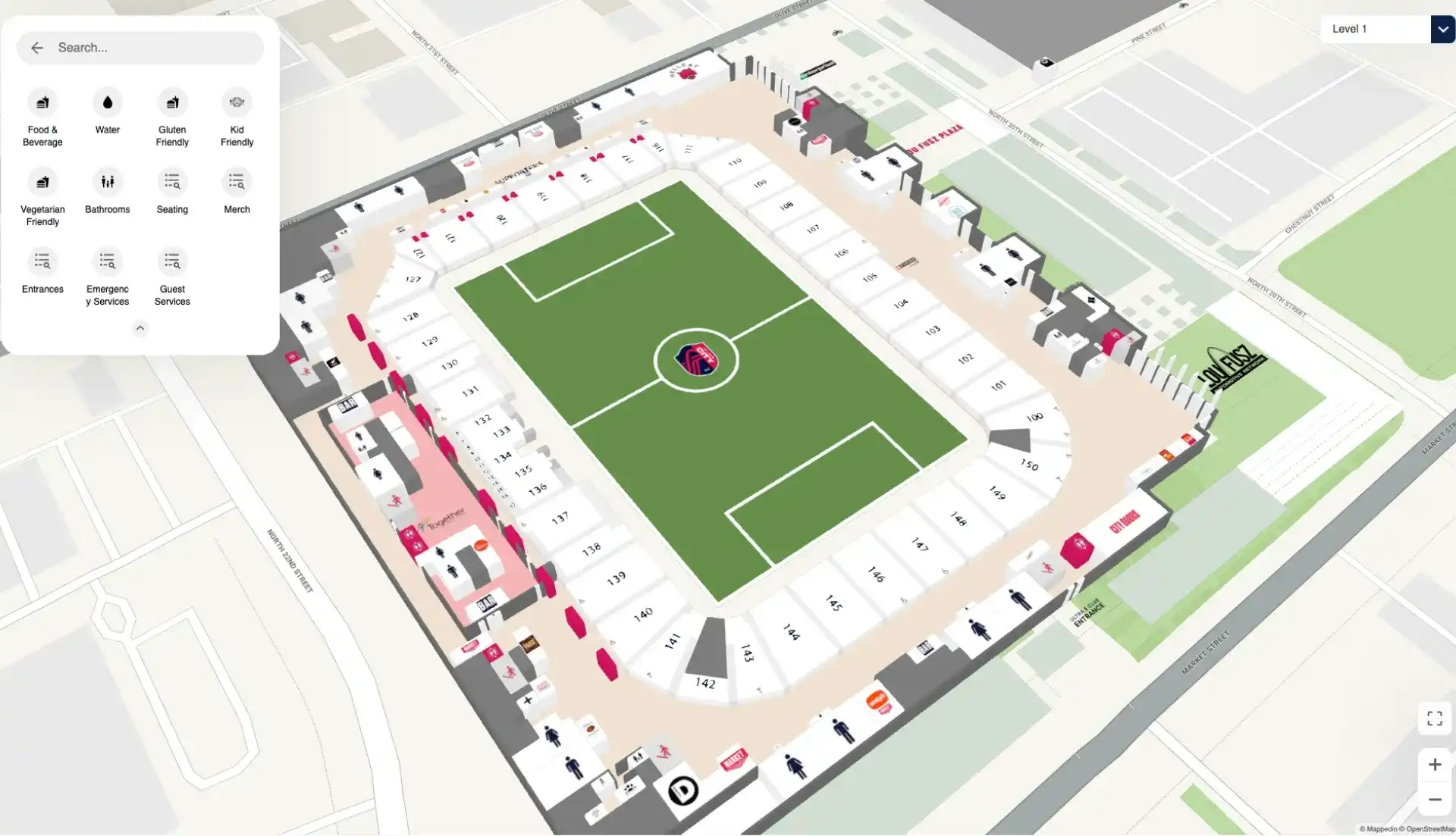
Mappedin delivers a mobile-optimized, 3D interactive mapping experience purpose-built for complex stadium layouts. The fan experience platform provides complete journey visibility across multiple floors and buildings simultaneously, showing fans their entire route in one view – including exactly which escalators to take, where to cross between concourses, and how to navigate around premium club areas that require separate ticketing.
On match days, the CITYPARK Interactive Stadium Map is currently sitting at the second most-used feature in the official St. Louis CITY SC App, and this is a behavior that we continue to see match-over-match.”
– Aaron Brewer, Senior Product Manager, Digital Experience at St. Louis CITY SC
How it works for fan engagement
- Fans access the map instantly via QR codes at entrances, direct links in "know before you go" emails, or embedded directly in team or venue mobile apps.
- The compact level selector allows simple floor navigation while taking up minimal screen real estate, and customizable label control prioritizes which destinations fans see at each zoom level.
- When fans search for their seat section, a concession stand, or guest services, the platform automatically generates turn-by-turn navigation with landmark-based directions that reference recognizable stadium features.
- The path overview slider tracks progress by actual distance traveled, giving fans real-time context about their journey.
How does digital wayfinding improve fan experience at stadiums?
- Dramatic reduction in guest services directional questions—Staff can hand out QR code access cards instead of spending 10 minutes explaining complex routes, freeing them to focus on actual guest experience issues.
- Higher fan satisfaction scores—St. Louis City SC achieved 84% satisfaction ratings with their interactive stadium map as the second most-used app feature.
- Improved concession discovery—Average stadium usage data shows thousands of searches per game as fans explore new food and beverage options instead of returning to familiar locations.
- Premium area routing control—Venues can use custom pathing to route general admission around club/suite areas, preventing frustrated fans from hitting ticket checkpoints while maintaining VIP exclusivity.

Feature #2: Self-service map updates and real-time control
Whether your stadium uses paper maps or custom-developed apps, traditional stadium mapping solutions create a painful cycle for real-time updates like:
- Reflecting a concession stand closure for game day
- Displaying a new sponsor location
- Updating parking instructions for a special event
With 2D PDF maps, you're stuck until the next expensive print run. With outsourced platforms, you're dependent on vendor response times and change request processes. The inability to make real-time updates means your maps never reflect actual current conditions, and fans learn not to trust them.
What makes Mappedin different
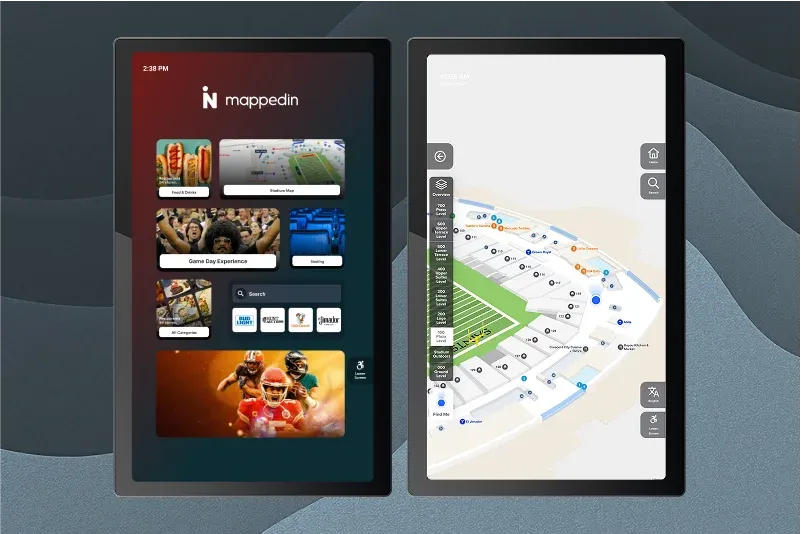
Mappedin provides an intuitive backend content management system that lets your team update maps independently, in real-time, without technical expertise or vendor dependencies.
Unlike other platforms with limited update flexibility, Mappedin was designed specifically for venues that need operational control over their wayfinding infrastructure. Everything stays white-labeled on your domain. Maps are hosted on your stadium's website, not redirecting to third-party URLs.
How it works for fan experience
Your operations or marketing team logs into the Mappedin CMS to make updates instantly:
- Update the pathing exclusion in minutes
- Add (or update) new vendors with location, category tags, and sponsor branding
- Adjust routing parameters to reflect current ticket checkpoint locations
All changes publish immediately to your live maps across mobile apps, websites, and any embedded implementations – no developer resources required, no vendor coordination needed, no expensive reprints.
How do self-service updates improve fan experience at stadiums?
- Immediate game-day adaptability—Operations teams can respond to last-minute changes (weather-related closures, staffing adjustments, event-specific routing) without relying on IT resources or external vendors.
- Significant cost savings versus paper maps—Eliminate expensive reprint cycles while maintaining perfect accuracy even as your venue evolves with renovations, sponsor changes, or seasonal amenity updates.
- Long-term scalability—Mappedin’s backend makes it simple to add to, update and expand your stadium’s digital infrastructure with no coding experience necessary.
- Complete brand control—Mappedin ensures everything stays on your stadium's domain with full white-label customization.
Feature #3: Revenue-generating sponsorship and promotional tools
Traditional static sponsorships on paper maps or PDF downloads provide sponsors with basic logo placements that generate no engagement data, offer no interactivity, and deliver no measurable ROI. Sponsors pay based on circulation numbers or impression estimates, but you can't prove anyone actually noticed their placement, much less acted on it.
Meanwhile, the venue misses opportunities to upsell premium digital placements or demonstrate sponsor value with concrete engagement metrics.
What makes Mappedin different
Mappedin transforms sponsorships from passive logo placements into active, searchable, discoverable destinations that fans interact with throughout their experience.
The platform allows you to showcase branded locations with high-quality header images that give each destination a distinct visual identity, making sponsors immediately recognizable on the map. Promotional banners on the homepage can feature rotating sponsor content with direct navigation links to their locations, and you maintain granular control over what content appears during different events or to different audience segments.

How to use Mappedin fan engagement software to increase stadium revenue
- Configure sponsored locations as top priorities in your map interface, ensuring they appear prominently in search results and category listings.
- Add rich visual content, promotional messaging, operating hours, and deep links to pre-ordering systems or digital content.
- The image floating label feature replaces generic category icons with location-specific branded visuals, providing a more engaging and contextual view of each sponsor destination.
- Track exactly how many fans searched for the "Miller Lite Club," viewed the sponsor location details, navigated to their space, and completed their journey—turning vague impressions into concrete engagement metrics you can share in sponsor renewal conversations.
Impact of sponsorship and promotion features on stadium revenue
- Premium sponsorship pricing—Branded, searchable digital map locations command significantly higher rates than static logo placements because sponsors receive interactive, measurable placements with proven engagement.
- New revenue streams to offset platform costs—Multiple venue clients have successfully positioned digital map sponsorships as a net-positive revenue generator rather than a pure operational expense.
- Sponsor retention and renewals—Provide concrete engagement data (searches, views, navigation completions) that prove ROI and justify premium pricing in renewal conversations.
- Concession discovery drives sales—Search data from name brand Bowl games shows fans actively explore new food and beverage options, indicating direct commercial intent and increased trial of different vendors.
Feature #4: Fan engagement analytics
Paper maps and static PDF downloads provide little to no data about fan behavior, popular destinations, or navigation patterns. You have no way to measure whether fans actually used the maps, which concessions they searched for, what routes they took, or where operational friction points exist.
Without data, you can't:
- Optimize concourse flow
- Improve signage placement
- Make informed decisions about amenity locations and staffing during peak times
- Make data-backed tenant leasing or sponsorship decisions
It's purely guesswork based on anecdotal staff observations and occasional fan complaints.
What makes Mappedin different
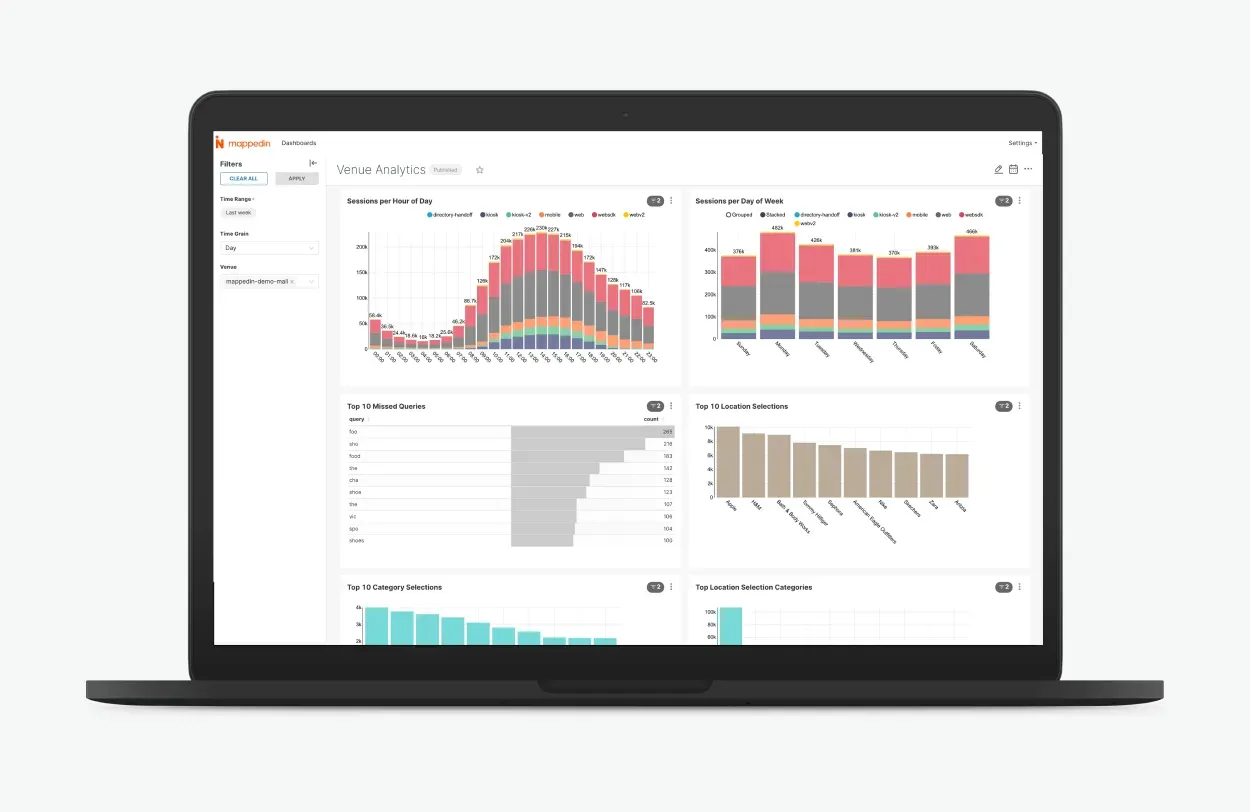
Mappedin provides pre-configured analytics dashboards that turn fan wayfinding behavior into actionable business intelligence.
The platform tracks every search query, destination view, navigation completion, and interaction, giving you quantitative data about how fans actually experience your venue.
Unlike basic analytics that only show page views, Mappedin's fan engagement analytics dashboards measure campaign effectiveness, identify top destinations and peak usage times, and connect wayfinding data to operational improvements and guest satisfaction scores.
How to measure fan engagement with Mappedin analytics
- Access real-time dashboards showing total sessions, unique devices, repeat usage patterns, and session duration by event, date range, or venue area.
- Analyze search data to understand what amenities fans look for most frequently: restrooms, specific concession types, merchandise locations, guest services, accessible routes.
- Track navigation patterns to identify which routes fans actually take versus your assumed flow, revealing where congestion occurs or where better signage might help.
- Measure promotional content engagement to prove sponsor ROI by showing exactly how many fans viewed featured locations or clicked through promotional banners.
Operational outcomes of fan engagement analytics
- Quantifiable usage proves platform value—Measure game-day behavior including locations searched, navigation paths, and advertising engagement, demonstrating how fans experience your stadium.
- Search intent reveals commercial opportunities—Analysis of thousands of searches per game shows which concession types fans seek most frequently, informing vendor mix decisions and identifying unmet demand for specific food/beverage categories.
- Peak time identification optimizes staffing—Understand exactly when fans engage most heavily with wayfinding (entry times, halftime, between periods) to align guest services staffing with actual demand.
- Data-backed operational improvements—Connect wayfinding friction points (abandoned searches, repeated queries for the same location) to signage gaps, confusing venue layouts, or areas needing better directional indicators.
Alternative fan engagement software solutions
When evaluating digital fan engagement software for your stadium or arena, you're likely considering several different approaches, like continuing with static maps to investing in custom platforms or working with competitors like PAM or Concept3D.
Here's an honest assessment of how each alternative stacks up for stadium-specific requirements.
Alternative #1: PAM
PAM positions itself as a navigation solution with visually appealing custom-built maps and a background in wayfinding signage. They serve major venues including portions of SoFi Stadium and have expertise in creating aesthetically pleasing static directional systems. PAM's approach centers on creating one-off, handbuilt map experiences with strong visual design.
PAM key features:
- Custom visual design with appealing map aesthetics
- Turn-by-turn navigation functionality
- Promotions and deals associated with locations
- Dynamic focus similar to modern mapping platforms
- Integration capabilities with venue signage systems
What type of venue is PAM best suited for?
Venues that prioritize visual design over operational flexibility, have limited need for frequent map updates, and don't require white-label solutions integrated into their own domain infrastructure would do well with PAM as their wayfinding solution.
Key limitations of PAM for stadiums:
- Not white-labeled—All maps hosted on PAM's domain, not your stadium's website, with URLs pointing back to pam.com
- Scalability concerns—More cumbersome to make backend updates when real-time changes are needed
- Vendor dependency—Updates require coordination with PAM rather than self-service management by your team
Alternative #2: Concept3D
While Concept3D focuses primarily on higher education campuses, they offer some crossover into stadium applications. Concept3D offers 3D virtual tours and basic wayfinding capabilities but lacks the commercial venue-specific features stadiums need for revenue generation and operational management.
Concept 3D key features:
- 3D virtual tour capabilities
- Basic indoor mapping and wayfinding
- Campus-oriented navigation tools
- Integration with educational technology platforms
- Outdoor campus mapping
What type of venue is Concept3D best suited for?
For stadiums, Concept 3D is a solid solution for college athletic venues focused primarily on student and alumni navigation rather than revenue optimization.
Key limitations of Concept3D for stadiums:
- Limited monetization opportunities—No built-in sponsorship or revenue-generation capabilities
- No digital directory solution—Cannot support in-venue kiosk or display infrastructure
- Higher Ed focus—Features center on campus needs rather than commercial venue operations
- Basic wayfinding—Mappedin offers superior functionality and easier map updates according to competitive analysis
Alternative #3: Traditional paper map PDFs
A common alternative to digital fan engagement platforms is continuing with paper maps distributed at entrances or PDF downloads accessible via your website. This represents the status quo at many venues and often seems like the "safe" choice because it requires no change.
Benefits of traditional, 2D stadium maps:
- Familiar format fans have used historically
- No technical integration required
- Works without mobile connectivity
- Can include extensive sponsor logos and branding
- Simple to explain to staff and stakeholders
When would a paper or PDF map work best for sports fan experience?
Very small venues with simple layouts, organizations with limited technology budgets, or scenarios where fan demographics genuinely don't use smartphones might do fine sticking with traditional 2D maps.
They are also great as a backup option alongside digital solutions for guests without mobile devices.
Key limitations of traditional PDF maps for stadiums:
- Unusable on mobile devices—Trying to use a PDF map on a phone is cumbersome. No zoom, no search, no interactivity.
- No real-time updates—Expensive reprint cycles mean maps are outdated the moment venue changes occur
- Zero engagement data—Limited measurement on fan behavior, popular destinations, or navigation patterns
- Staff burden—Guest services teams still spend 10+ minutes per directional question because fans can't successfully navigate with static maps
- Lost sponsorship revenue—Static logo placements generate minimal value compared to interactive, searchable branded locations
- Poor discovery—Fans can only find what they already know exists, missing opportunities to explore new concessions and amenities
How to choose the right fan engagement software
The stadium and arena industry has reached a clear inflection point. The question all venues and teams need to ask is “which approach will deliver the best combination of operational efficiency, revenue generation, and measurable fan satisfaction improvements while maintaining long-term flexibility as the stadium evolves?”
AT&T Stadium, St. Louis City SC, Australian Grand Prix, and FedEx Field have all chosen Mappedin to power their digital fan engagement strategies. They're seeing:
- measurable improvements in guest services efficiency (reducing the staff time burden of directional questions)
- new sponsorship revenue from branded searchable locations
- actionable analytics that inform everything from concession mix decisions to operational staffing during peak entry times
— Joel Mackenzie, Digital Manager, Australian Grand Prix Corporation
The venues winning at fan engagement aren't waiting for perfect conditions or comprehensive multi-year digital transformation initiatives. They're taking focused, measurable steps to solve specific operational problems – and discovering that modern digital wayfinding platforms deliver benefits far beyond simple navigation.

Share