

According to our State of Venue Experience report, 53% of visitors experience at least one navigation problem per visit in large facilities.
Hospitals, with their multi-building campuses, inconsistent naming conventions, and constant construction, are among the most navigationally complex environments people encounter. The problem is rarely that wayfinding is absent. It's that wayfinding degrades incrementally over time, renovation by renovation, until the cumulative friction is embedded in every patient journey.


Unlock better patient experience with interactive wayfinding
For most patients, the care experience doesn't begin in the exam room. It begins in the parking garage, at a lobby directory, or on a phone screen. This guide gives Patient Experience leaders a practical framework for turning wayfinding from a persistent pain point into a coordinated, measurable program.
How to audit your hospital's wayfinding problems
Most hospital operations teams know wayfinding is an issue. Fewer have a structured way to measure exactly where it breaks down or how much it costs. Before evaluating hospital wayfinding solutions, digital or otherwise, you need gather data. Three sources give you the clearest picture.
Search your patient feedback for wayfinding signals
Patient complaints about wayfinding rarely get categorized that way. They show up as frustration about late arrivals, confusion about parking, or vague dissatisfaction with "the experience." Pull complaint data, post-visit surveys, and online reviews, then search for terminology patterns:
- "couldn't find"
- "got lost"
- "late because"
- "confusing layout"
- "wrong building"
Shadow the staff who direct patients and visitors
Follow your volunteer desk staff, front desk teams, and security guards for a single shift. Count how many interactions are purely directional.
That's staff time pulled directly away from patient care and operational tasks. Quantifying this number is one of the fastest ways to build an internal case for change.
Correlate missed appointments with building location
Pull no-show and late-arrival rates by department and cross-reference them with building location. Departments in hard-to-find areas like satellite buildings, upper floors of newer additions, or clinics that recently moved almost always show higher late-arrival rates.
These are your wayfinding bottlenecks, and they cost real money.
Across hundreds of appointments per day, the operational impact adds up fast.
If your information desk is fielding more than 30 directional questions per hour during peak times, or if late-arrival rates in certain departments consistently exceed 10%, wayfinding is actively undermining your operations.
Quick wins that don't require technology
Not every wayfinding improvement requires a technology investment. Several low-cost fixes can reduce friction immediately.
Standardize how every staff member gives directions
Hospitals often have internal codes and legacy names for buildings and wings that mean nothing to patients. If your staff calls it "the B wing connector" but your signage says "North Pavilion," patients will get lost at that junction every time. Create a single, patient-facing naming convention and train every team — clinical, volunteer, front desk, security — to use it.
Audit signage at your five highest-traffic decision points
These are almost always the main entrance, elevator banks, major corridor intersections, parking structure exits, and department check-in areas. Walk these routes as a first-time visitor. If a sign requires you to already know the layout to interpret it, it's not doing its job.
Add QR codes at known problem areas
Place QR codes on existing signage at the junctions where patients most often ask for help. Link them to a simple directions page or map. This is low-cost and gives patients a self-service option without replacing your existing signage infrastructure.

Create a wayfinding cheat sheet for front-line staff
Document the ten most-requested routes with landmark-based directions and distribute them to every volunteer and front desk team member. This reduces variability and cuts the time each directional interaction takes.
While these fixes in the short term, they improve symptoms without addressing the underlying complexity of navigating a multi-building, multi-floor campus that changes every time a department moves or a construction project reshapes a corridor.
Signage is critical in a hospital and it likely always will be. But what happens when signage alone can't keep up?
When to invest in a digital wayfinding system
Signage handles steady-state navigation well, but signage alone isn't adaptable on its own. And hospitals are among the least static environments a wayfinding system has to serve. Use these five signals to know when your hospital has outgrown signage-only wayfinding:
1. Multiple buildings or campuses with cross-facility patient journeys.
When a patient's visit spans two or three buildings, static signs at each individual building can't convey the full route. Patients need a way to see the complete journey before they start walking.
2. Frequent construction, renovations, or department moves.
Every time a clinic relocates or a corridor closes for construction, your signage is wrong until someone physically replaces it. Digital maps can be updated within hours and pushed to every patient touchpoint simultaneously.
3. Multilingual patient populations.
If your community speaks five languages and your signage is in two, a significant share of visitors is navigating without guidance.
4. Accessibility requirements beyond basic ADA (or non-US equivalent) compliance.
Step-free routing, screen reader compatibility, and elevator-priority pathfinding are difficult to deliver through signage alone.
5. Patient experience scores around navigation consistently underperforms.
If the data from your audit tells you wayfinding is dragging down satisfaction, incremental signage updates won't close the gap.
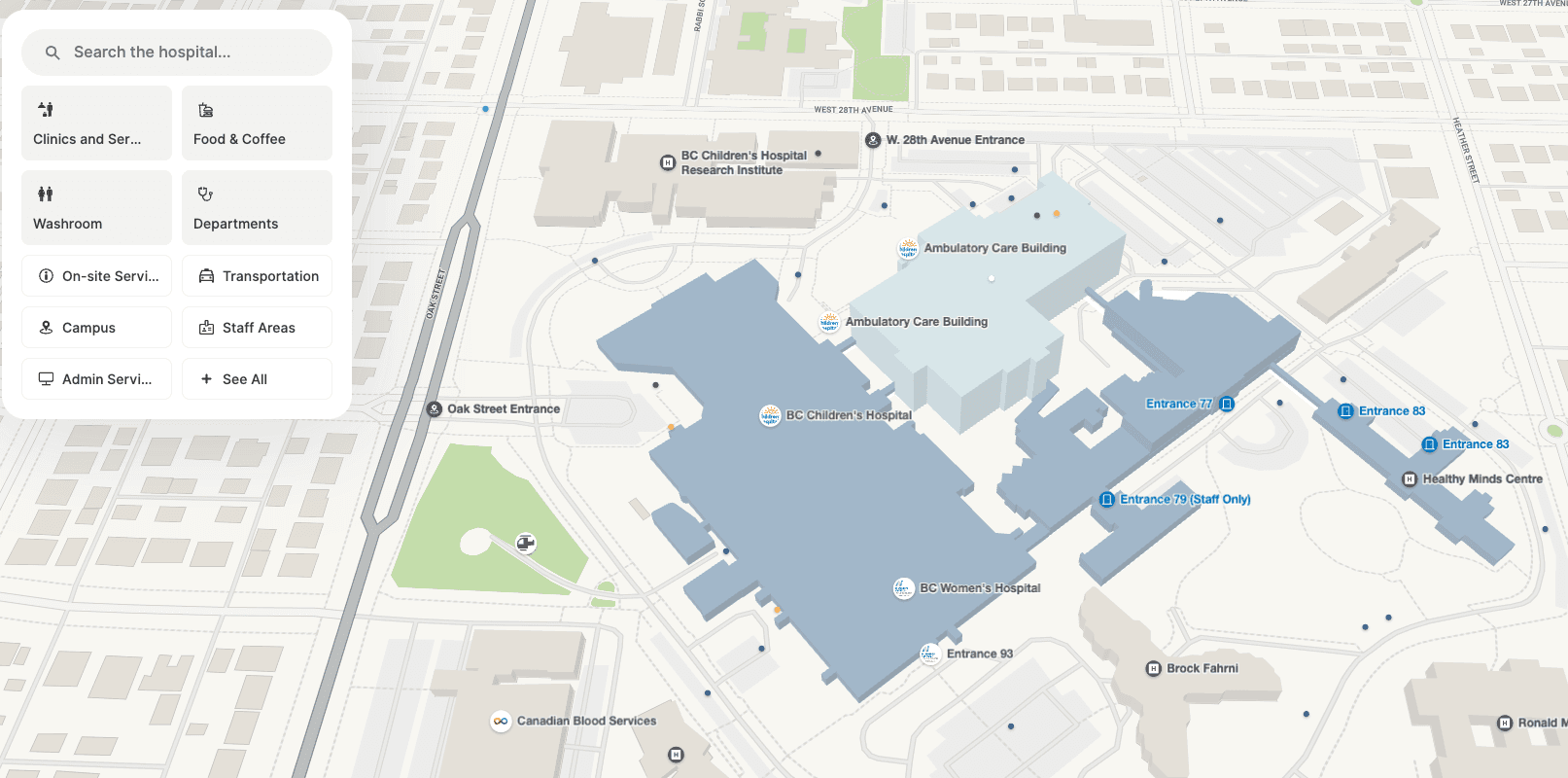
It's true: Digital wayfinding doesn't replace signage. Instead, it acts as a supplemental layer that handles what signage can't:
- Real-time updates when the facility changes
- The ability to send a patient a route directly to their phone before they arrive
- A connection point to your broader digital ecosystem.
For a deeper look at what implementation involves, Mappedin's guide on how to implement a hospital wayfinding system covers the process from planning through launch.
Read the guide on how to implement a hospital wayfinding system →
Criteria for the best hospital indoor mapping software solutions
Several platforms serve hospital wayfinding needs, each with different strengths. See our comparison of the best hospital navigation apps to evaluate the leading options in detail. A few criteria matter most when evaluating solutions for healthcare.
Accuracy and update speed
The map has to stay current as your hospital changes. If updating a department move takes weeks of vendor coordination, the system will fall behind your facility, and an outdated map is worse than no map. Look for platforms with self-service content management that lets your team push changes in real time.
Accessibility and language support
Hospitals serve everyone. WCAG 2.1 AA compliance, step-free routing, and screen reader support are non-negotiable. Multilingual support matters too. Mappedin, for example, supports 40+ languages, which is critical for hospital systems serving diverse communities.
Integration with existing tools
Digital wayfinding delivers the most value when it connects to your patient portal, appointment reminders, or hospital app so a patient can receive a direct link to their route before they leave home. The wayfinding layer becomes foundational infrastructure that your other digital tools build on, not a standalone product.
Low infrastructure requirements
Mappedin's infrastructure-free positioning means hospitals don't need to install beacons or run new cabling through sensitive clinical environments. With over 10 billion square feet mapped globally, the platform is built for the scale and complexity hospital campuses demand.


Start with what you can measure
Hospital wayfinding problems are solvable, but only if you treat them as operational issues with measurable costs and not as an inevitable quirk of complex buildings.
Audit where patients get lost, quantify the staff time and missed appointments that result, and fix what you can with naming standards, signage improvements, and better front-line tools.
When your facility's complexity outpaces what static signage can handle, a digital wayfinding layer closes the gap without requiring infrastructure overhauls. The hospitals that get this right will drastically reduce patient confusion and recover untapped capacity across every department.


Share