Every facilities director faces the same decision: maintain traditional wayfinding systems—static signage, printed maps, physical directories—or invest in modern indoor digital wayfinding software. The performance gap between these approaches has never been wider, and the cost difference isn't what most decision-makers expect.
This analysis breaks down the true three-year total cost of ownership for both approaches, including the hidden operational expenses most facilities never calculate. You'll see real-world scenarios showing operational impact, actionable use cases, and a decision framework based on facility type and operational complexity.
Let's examine what traditional wayfinding actually costs, including the expenses that never appear on the initial invoice.
Looking for an indoor mapping solution to power visitor navigation, simplify operations, and improve venue analytics? Book a custom demo of Mappedin →
What is traditional wayfinding?
Traditional wayfinding encompasses the physical navigation systems most facilities have relied on for decades: directional arrows, room numbers, department identification signs, static floor directories, "you are here" building maps, and printed materials handed to visitors at reception desks. Some facilities also include branded wayfinding elements like color-coded floor systems or donor recognition integrated with directional signage.
The reality extends well beyond signs mounted on walls. Your average large venue manages 1,000 to 3,000 individual signs requiring dedicated maintenance schedules, manual database tracking for inventory management, coordination across multiple departments for any updates, and physical installation or replacement teams for every change. Each sign represents a fixed data point that requires manual intervention to update.

Traditional wayfinding made operational sense when buildings maintained relatively static configurations, when tenant or department changes happened annually rather than monthly, when visitor volumes remained predictable, and when accessibility requirements focused primarily on basic compliance rather than personalized routing options. The expectation of multi-language support was limited, and venues could reasonably assume most visitors spoke the primary local language.
Today's venues operate under entirely different constraints:
- Department or store relocations happen quarterly
- Temporary spaces emerge during renovations
- Events require dynamic routing
- Accessibility needs vary significantly across your visitor population
What do traditional wayfinding systems cost?
Initial implementation investment
The upfront investment for traditional wayfinding varies significantly based on facility size, sign complexity, and material specifications.
- Design and planning consultation typically runs $5,000 to $15,000, covering wayfinding strategy, sign location planning, and design specifications.
- Individual sign production costs range from $20 for basic room identification plates to $200 for large illuminated directional signs, depending on size, materials, and lighting requirements.
- Professional installation labor adds $50 to $150 per sign depending on mounting complexity and location accessibility.
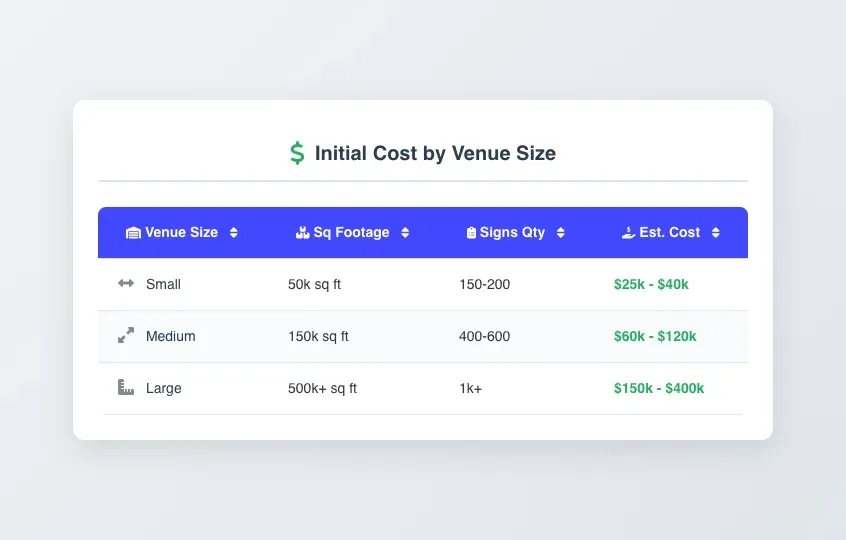
For a facility implementing 200 signs, total upfront investment typically ranges from $25,000 to $75,000. The math scales predictably:
Initial cost by venue size:
- Small venue (50,000 sq ft, 150-200 signs): $25,000-$40,000
- Medium venue (150,000 sq ft, 400-600 signs): $60,000-$120,000
- Large venue (500,000+ sq ft, 1,000+ signs): $150,000-$400,000
Maintenance investment
Annual ongoing costs consistently surprise facilities that budget only for initial installation. Sign maintenance and replacement typically costs $5,000 to $20,000 annually, representing roughly 10-20% of your initial investment every year. This covers damaged signs from equipment impacts, cleaning equipment contact, or vandalism; faded signs from sunlight exposure or age requiring replacement every 5-7 years; weather damage for any outdoor signage; and broken mounting hardware or fixtures.
Update costs accumulate quickly when operational changes occur. For example:
- A department or tenant relocation requiring new directional signage runs $3,000 to $8,000 covering design modifications, production, old sign removal, and new installation.
- New tenant moves or space reallocations cost $2,000 to $5,000.
- Organization-wide branding updates requiring consistent signage replacement can reach $10,000 to $30,000.
Your average facility makes 3-5 significant changes yearly, translating to $15,000 to $40,000 in annual update costs beyond routine maintenance.
Operational costs
Hidden operational costs never appear on signage invoices but represent substantial ongoing expenses.
Staff time spent giving directions typically consumes 15-30% of front desk and reception capacity. For a hospital employing two full-time receptionists at $40,000 annual salary, that represents $12,000 to $24,000 in lost productivity annually.
Your facilities team dedicates time managing sign inventory, coordinating maintenance, and processing update requests.
Employees and visitors lose productivity when navigation fails. And when navigation tools are introduced? Studies show no-show rates declined from 50% to 30% after implementation of the patient navigator program.
The cost of scalability
Traditional wayfinding costs scale proportionally with facility growth. More buildings require proportionally more signs, while larger facilities demand proportionally higher maintenance investment. Multi-campus operations multiply everything by location count.
Unlike wayfinding software solutions that achieve economies of scale, traditional wayfinding offers no cost efficiency at larger deployments. Your tenth building costs the same per square foot as your first building.
Beyond cost: Other downsides to traditional wayfinding systems
Specific operational scenarios expose obvious limitations of traditional wayfinding systems:
- Emergency evacuations with blocked routes can't be communicated through static signage
- Temporary department relocations during construction or renovation leave outdated wayfinding information in place for weeks or months.
- Event-based navigation for conferences, orientations, or special programs requires temporary supplementary signage.
Then, there’s the issue of accessibility. A critical factor for an inclusive and compliant venue, accessibility should be prioritized rather than an afterthought. Accessible navigation for different mobility requirements—wheelchair or stroller users, visitors avoiding stairs, those requiring elevator-only routes—demands duplicate sign systems and multi-language support requires completely separate signage sets.
How indoor mapping software works for digital wayfinding
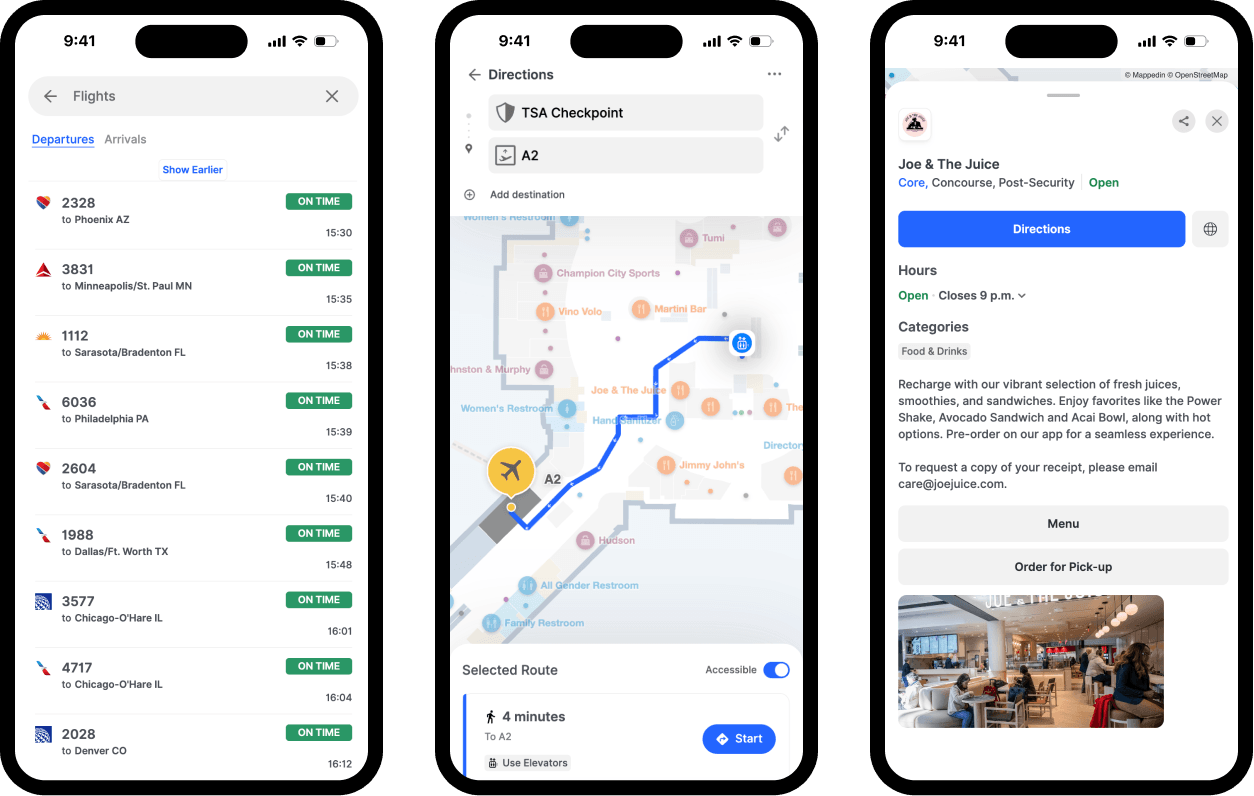
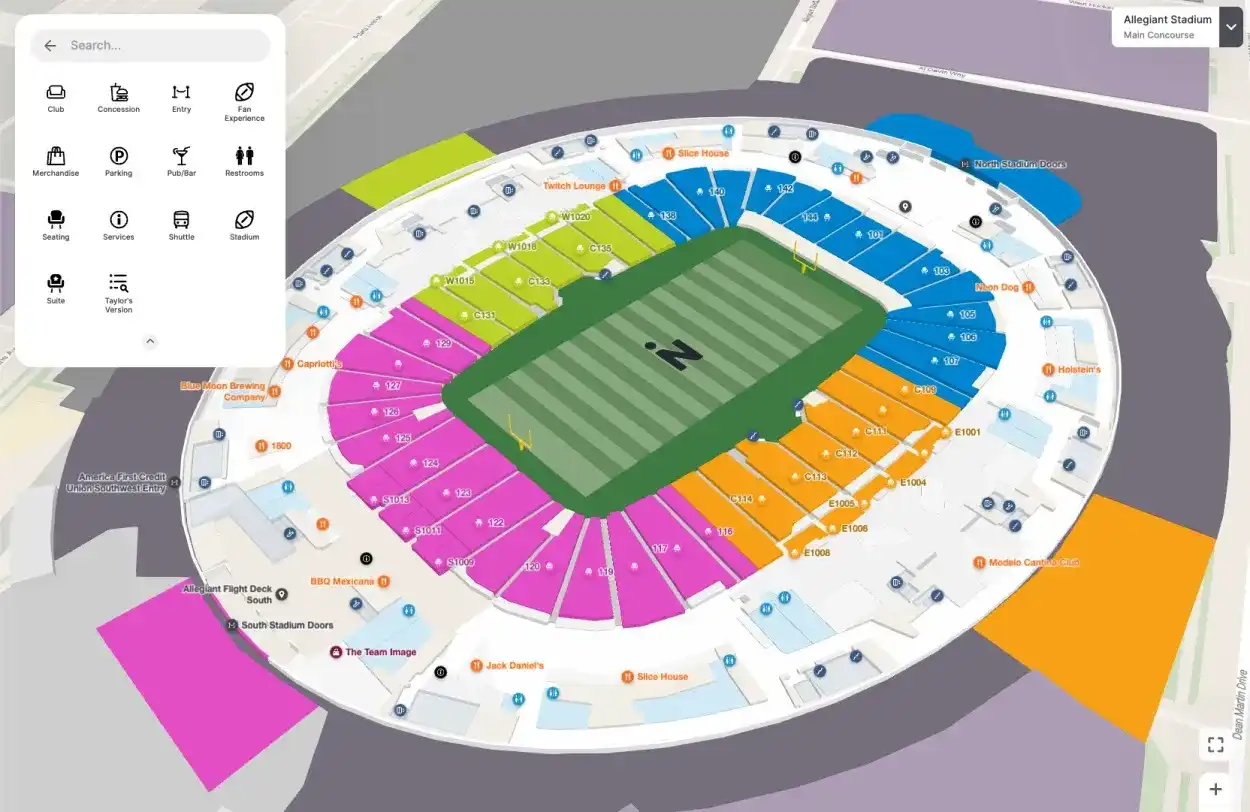
Modern indoor mapping software like Mappedin delivers interactive digital maps through web browsers, mobile applications, and dedicated kiosk displays.
The platform provides turn-by-turn navigation similar to GPS systems, accessible through whatever devices your visitors already carry. A cloud-based content management system allows authorized staff to update maps from anywhere without technical expertise., and multi-platform delivery means the same map data serves your website, mobile app, digital signage, and wayfinding kiosks simultaneously.
Mappedin is designed for venue experience and operations, with features purpose-built to serve both teams:
- Accessibility routing enables wheelchair-accessible path filtering, elevator-only routes, and stair-free navigation—personalized based on individual visitor needs rather than one-size-fits-all directional signs.
- Discovery features like search functionality allow visitors to find specific rooms, people, departments, services, or amenities by name rather than trying to interpret building abbreviations or floor numbering systems. According to The State of Venue Experience, visitors who use indoor maps discover new places 62% easier than those relying on traditional signage alone.
- Integration capabilities connect your wayfinding system to room booking platforms, building management systems, event calendars, employee directories, and parking systems.
Interested in seeing how Mappedin can power exceptional visitor experiences at your venue? Get a personalized demo →
Digital wayfinding software implementation process
Initial setup involves converting your CAD files to interactive digital maps through largely automated processes. Configuration adds your points of interest, routing logic, accessibility data, and search parameters. Deployment embeds the map functionality on your website, mobile app, or digital kiosk hardware.
Ongoing management happens through the cloud-based CMS—updating a room name, changing a department location, or adding a new point of interest requires no technical expertise and publishes changes in minutes rather than weeks.
Wayfinding software advantages
1. Update speed
The ability to manage venue information on the backend represents perhaps the most significant operational difference. Publishing a change takes minutes rather than the 6-8 weeks required for traditional signage updates. Update cost drops to essentially zero—no design fees, production costs, installation labor, or coordination overhead.
2. Accessibility & compliance
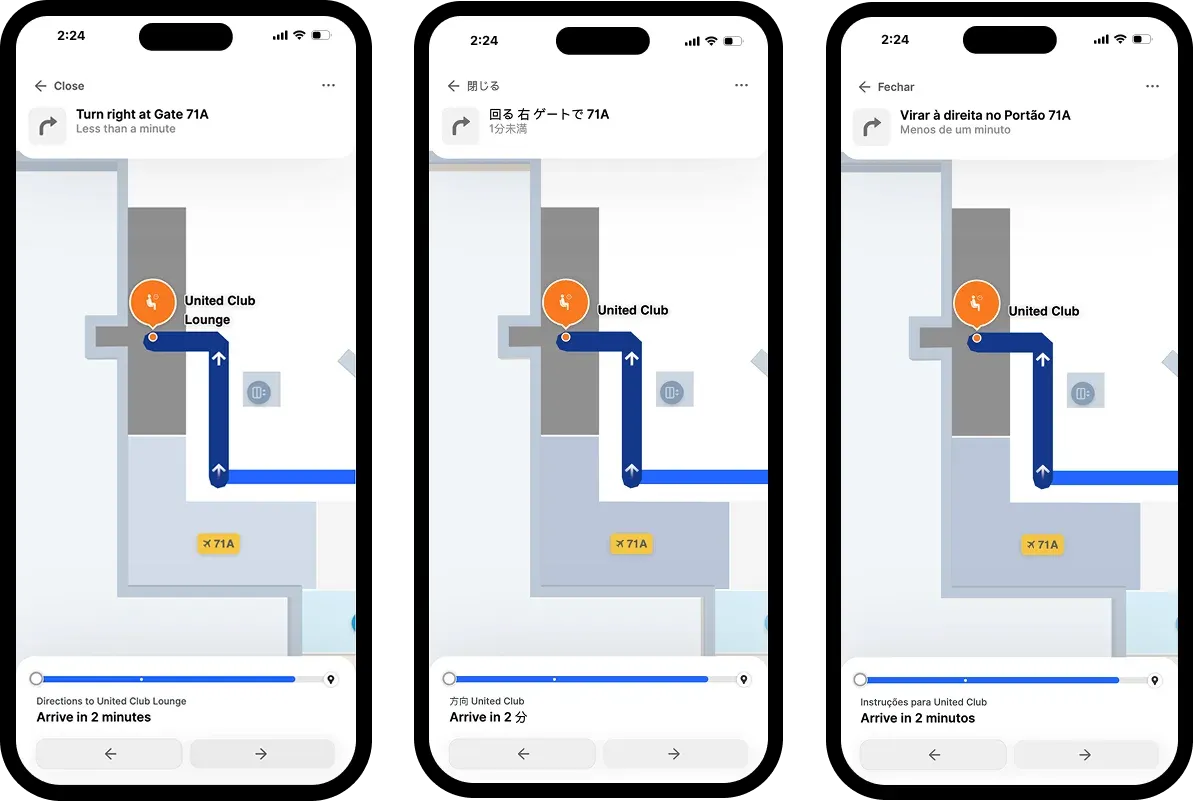
Traditional wayfinding delivers one-size-fits-all routing. But on the other hand, digital wayfinding can serve all visitors inclusively:
- Wheelchair-accessible route filtering that shows only paths without steps or stairs.
- Elevator-only or stair-free routing options accommodate visitors who can't navigate stairs for any reason.
- Multi-language support offers visitors navigation in their preferred language.
- Visual impairment accommodations include high-contrast modes and screen reader compatibility.
3. Data-driven optimization
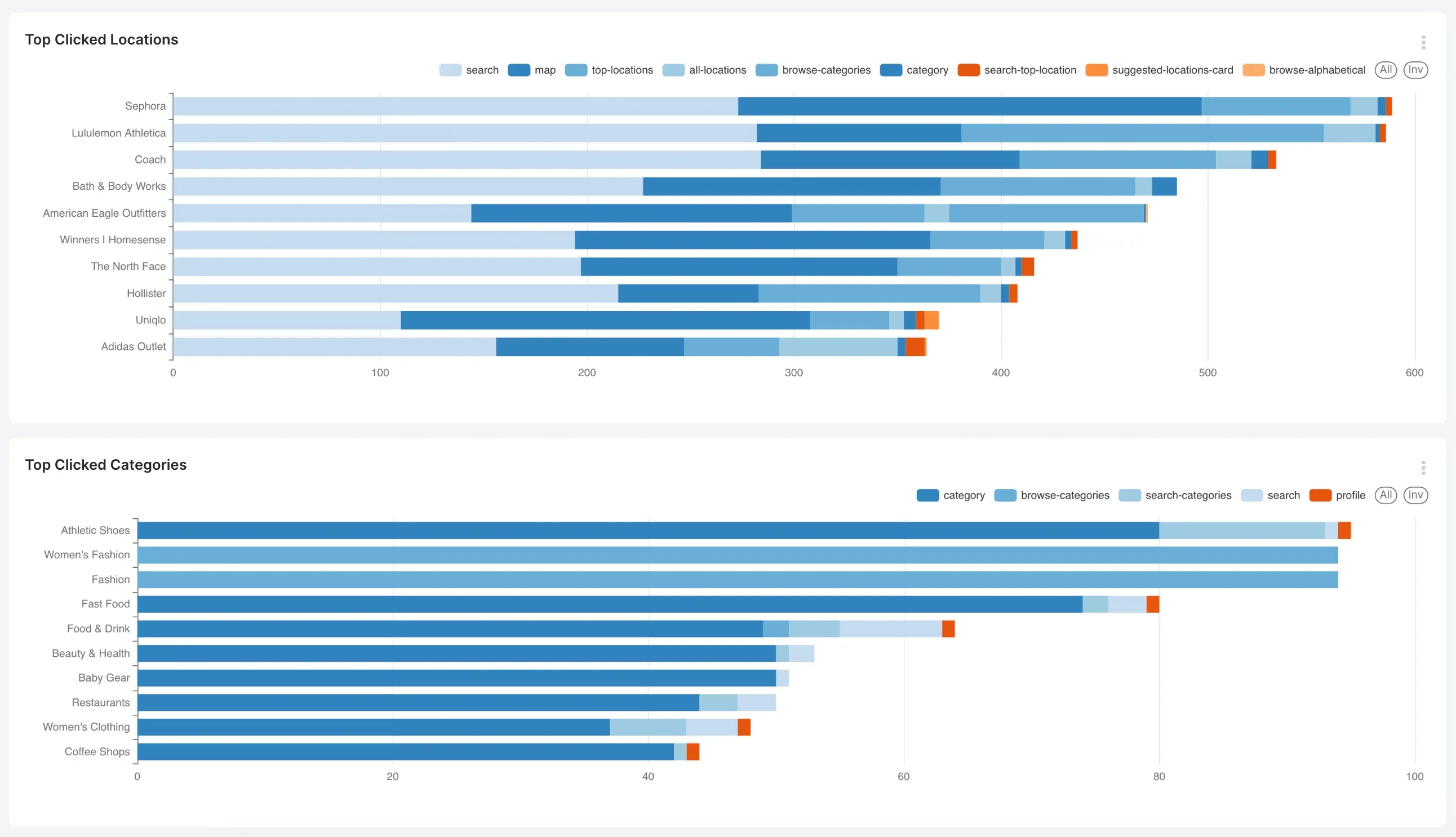
With traditional wayfinding tactics like physical signage and staff assistance, you have no data on what destinations people search for most frequently, which routes they prefer, where navigation failures occur, or when peak wayfinding demand happens.
Digital wayfinding offers actionable intelligence. For example, some wayfinding software offers analytics, which can show you most-searched destinations, common navigation bottlenecks, popular tenants, and other venue data.
4. System integrations for digital infrastructure
A major downside to traditional wayfinding is that it exists as a standalone system requiring manual coordination with other facility systems. Changes to tenants, room bookings, employee locations, airline gates, event schedules, or facility operations require separate manual updates to wayfinding information.
Digital wayfinding software can integrate directly with other building systems, eliminating manual coordination overhead and ensures your navigation information remains current even as systems update.
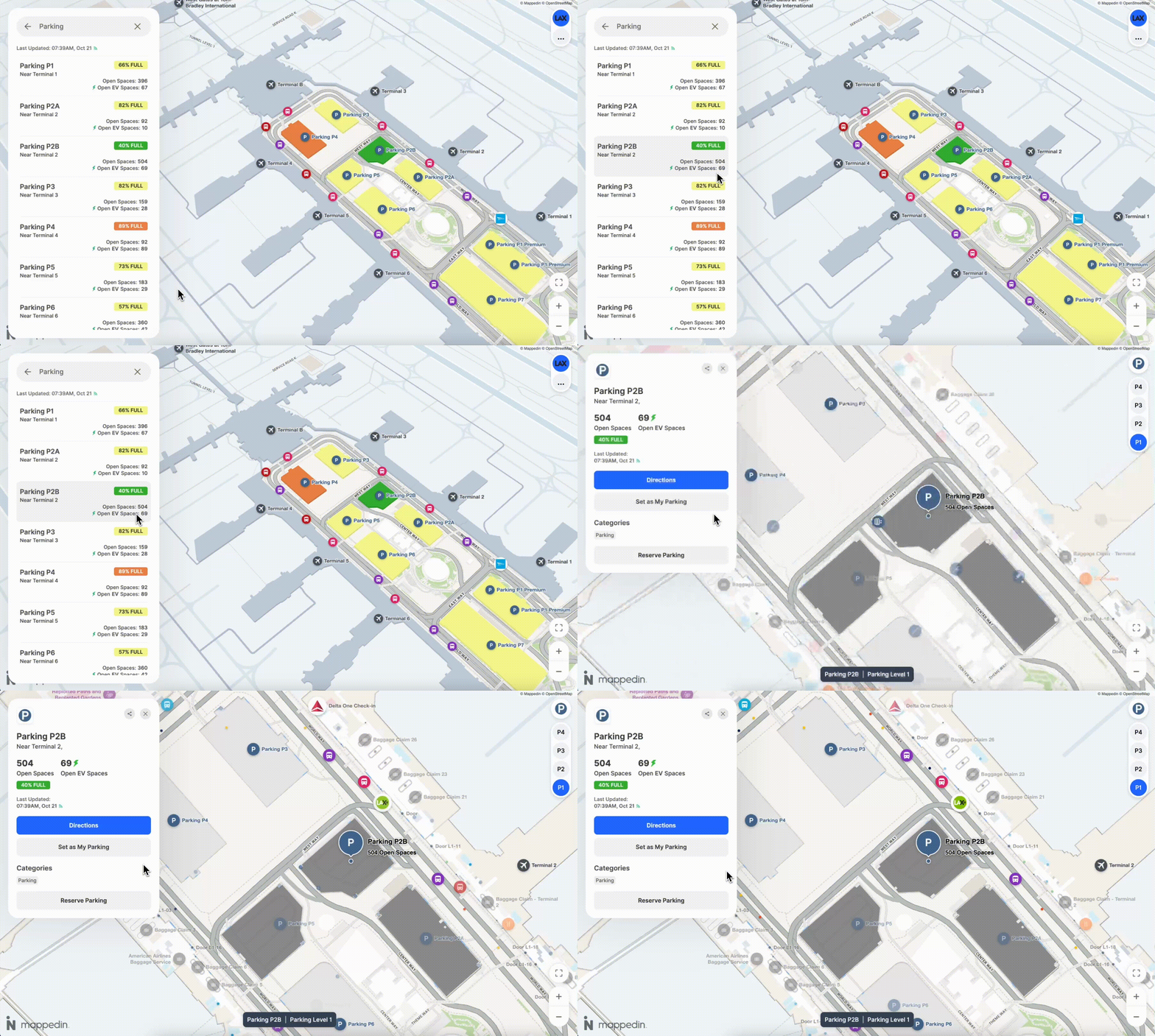
For example, parking system integration like the one LAX uses within their digital map infrastructure can provide complete door-to-door navigation from parking spot to final destination.
How to combine traditional wayfinding and digital wayfinding for optimal venue experience
While digital wayfinding is essential for venues looking to serve the modern visitor and streamline operations, traditional methods like physical signage and human assistance still play an important role in a visitor’s journey. Many facilities successfully implement hybrid solutions combining minimal complementary physical signage with comprehensive digital indoor mapping.
Strategic physical signage placement
Emergency exit signs remain code-required regardless of digital systems, while restroom identification using universal symbols and primary wayfinding at main entrances serve visitors who prefer physical reference points.
Digital-first navigation infrastructure
Detailed navigation via mobile devices and web browsers serves the 77% of visitors who actively use digital tools, while interactive kiosks at key decision points accommodate those without smartphones. Real-time update capabilities and analytics maintain accuracy and enable continuous optimization based on actual usage patterns.
Complementary system benefits
The hybrid model satisfies diverse visitor preferences while reducing required digital display hardware investment and maintaining emergency evacuation routing during power or network failures. Facilities typically achieve significant cost savings versus full traditional signage while retaining the flexibility and update speed of software-based systems.
Data-driven implementation strategy
Start with comprehensive software-based wayfinding deployed across web, mobile, and strategic kiosk locations. Then, add complementary physical signage only at high-traffic confusion points identified through analytics rather than assumptions, allowing actual visitor behavior data to drive your supplementary signage investment decisions.
Getting started with digital wayfinding
Let’s be honest: The true cost of traditional wayfinding extends well beyond initial sign purchase orders.
When you calculate maintenance expenses, update costs, staff time consumed giving directions, and lost opportunities for facility optimization, software-based indoor mapping typically delivers significant cost savings over three years while providing dramatically superior visitor experience and operational flexibility.
For most venues over 50,000 square feet with any expectation of operational change, indoor mapping software is the only scalable solution that adapts to your needs rather than forcing you to adapt to its limitations. The venues achieving best results treat wayfinding as a dynamic system requiring flexibility rather than a static installation requiring maintenance.
Related resources:

Share