

Stadium operations teams face a wayfinding problem that's uniquely unforgiving.
In our recent report, 53% of visitors experience at least one navigation problem per visit, and nearly 1 in 4 say they've wasted time searching for amenities in the last six months. In a venue holding 50,000 fans, that's a lot of frustrated people asking the same questions at guest services.
The stakes compound on match day. Day-of-game changes like a closed staircase, a relocated sponsor activation, or a new entry flow need to reach fans before they've already walked the wrong way. And the same map that helps a fan find the craft beer stand also needs to support operations teams routing first responders, managing crowd flow, and activating emergency protocols.
Concept3D has name recognition in campus mapping, but stadium and arena operations teams increasingly find it built for the wrong buyer.
In this blog, we compare the best Concept3D alternatives for sports stadium wayfinding—evaluated on the capabilities that matter most to guest services and fan experience teams.
Ready to see what a stadium-first wayfinding platform looks like? Try an interactive demo of Mappedin →
What to look for in a stadium wayfinding solution
Based on what matters most to guest services and fan experience professionals evaluating indoor mapping platforms, four capabilities consistently drive the buying decision at stadiums and arenas:
Real-time map control without vendor dependency
Stadium environments change constantly — not just season to season, but hour to hour on event day. A closed concession, a temporary sponsor footprint, a restricted staff corridor. Platforms that require a support ticket to update a floor plan aren't built for game-day operations.
The right solution puts map editing directly in the hands of your team, with changes reflected instantly for fans already inside the building.
Mobile-first navigation that works without hardware.
In today's culture, most fans navigate on their phone. A wayfinding solution that requires beacon hardware throughout the stadium—procurement, installation, battery maintenance, ongoing calibration—creates operational overhead that guest services teams can't sustain.
Beacon-free positioning that used existing infrastructure delivers the same turn-by-turn fan experience without the hardware burden.
Revenue-generating features, not just navigation
The application of a stadium wayfinding solution goes beyond fan engagement—it also includes monetization and revenue-generating capabilities. Branded, searchable concession and sponsor locations command premium placement value. Search data from inside the app reveals buying intent.
Platforms that treat wayfinding as a pure navigation product leave revenue on the table that operations and marketing teams can capture.
A dual-purpose platform that serves operations, not just fans
Fan experience and stadium operations need to work from the same map. Emergency management, crowd routing, first responder navigation, and access control all benefit from the same spatial data powering fan-facing wayfinding.
Separate systems for fan experience and operations create data silos, duplicated maintenance, and a slower response when something goes wrong on event day.

Mappedin
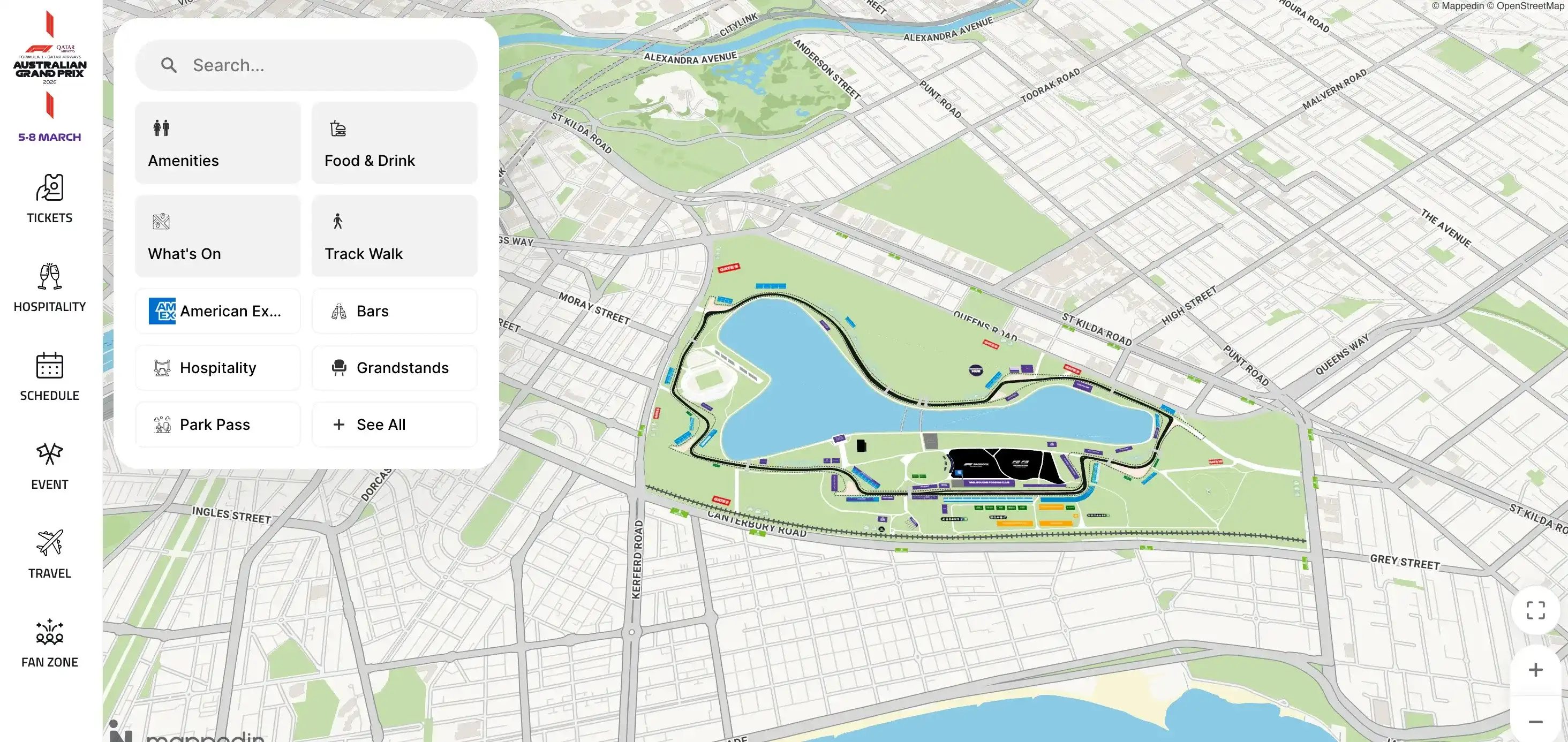
Mappedin is an indoor mapping and digital wayfinding platform built for commercial venues — including stadiums, arenas, airports, malls, and university campuses. It's the platform behind enterprise deployments at the Cotton Bowl, the Australian Grand Prix, and multiple MLS and NFL team apps, and it's designed to serve both the fan-facing and operational sides of a stadium from a single map layer.
1. Real-time map updates controlled by your team
Mappedin gives Stadium Ops and Guest Services teams direct, self-serve control over their maps through a purpose-built CMS:
- No vendor queue
- No file submissions
- No waiting
When a concession closes an hour before kickoff, your team updates the map and the change is live before the first fan scans a QR code at the gate.

Mappedin's AI-assisted map creation tools also dramatically reduce the time it takes to build and maintain accurate floor plans. For stadiums managing multiple event configurations, the ability to toggle map states and manage different floor plan versions from a single dashboard is a meaningful operational advantage. Updates that once required GIS staff or vendor intervention now take minutes.
2. Beacon-free indoor positioning
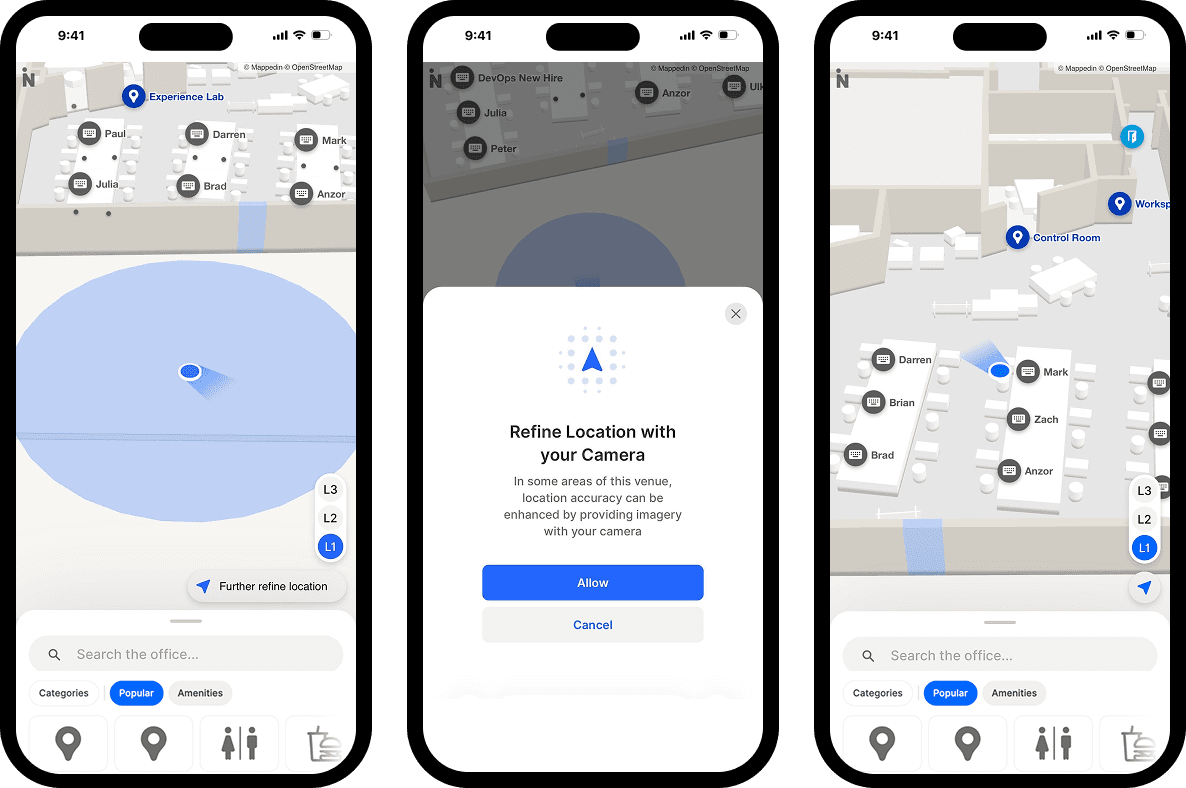
Mappedin delivers mobile turn-by-turn navigation without requiring any beacon infrastructure. Using existing infrastructure, the platform provides accurate indoor positioning throughout the stadium bowl, concourses, seating and premium areas—no Bluetooth beacons necessary.
For stadium operations teams, this matters at two moments: deployment and ongoing maintenance.
- Deploying beacons through a 60,000-seat stadium is a multi-month infrastructure project.
- Maintaining them (replacing batteries, recalibrating after renovations, managing device inventories) is a recurring burden that falls on whichever team draws the short straw.
Beacon-free positioning eliminates both problems and still delivers the blue-dot navigation experience fans expect.
3. Built-in revenue and sponsorship tools
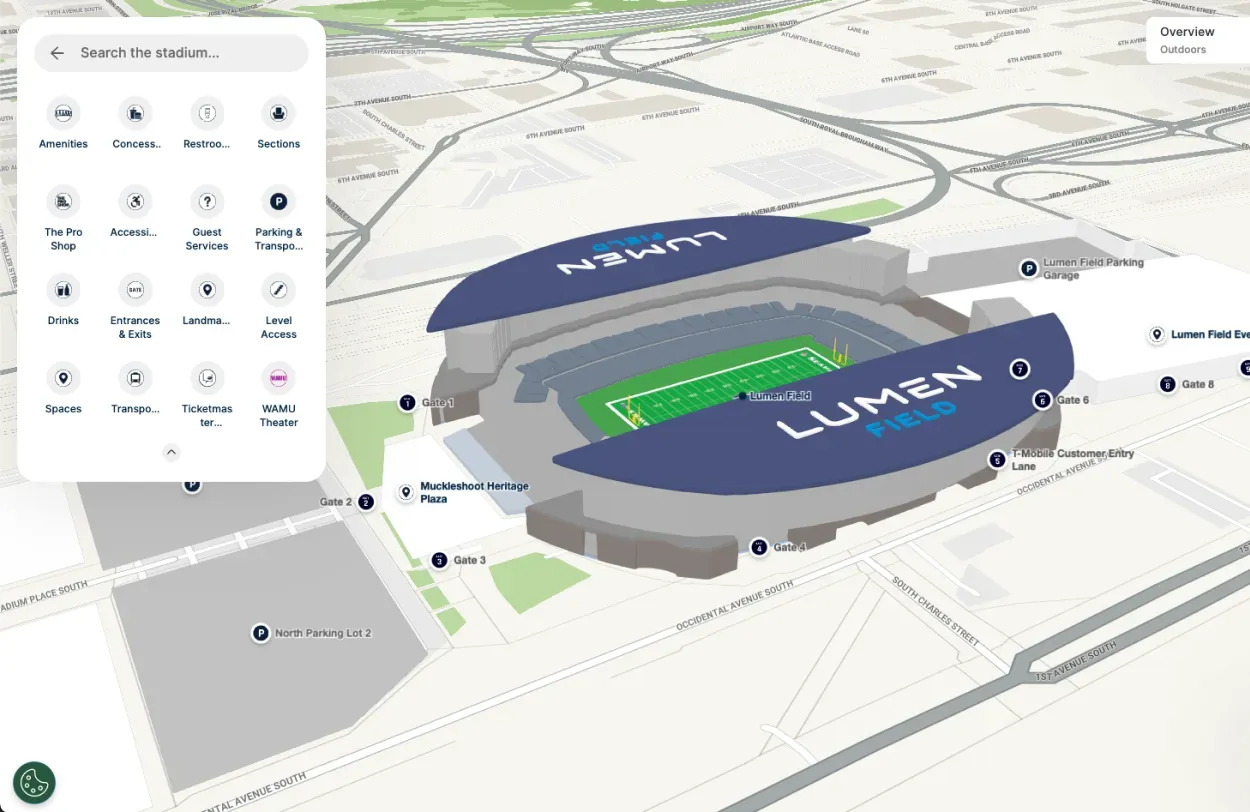
Mappedin's platform transforms wayfinding into a commercial asset. Branded, searchable concession and sponsor locations within the map create premium placement inventory—a measurable upgrade from a static logo on a PDF map. Sponsors pay for discoverability, and Mappedin delivers it through a searchable, fan-facing interface that captures intent at the moment a fan is looking for somewhere to go.
One major Bowl game saw over 26,000 map sessions on a single game day, generating rich search data that reveals exactly what fans are looking for—and where venue revenue is being left on the table.
That data feeds directly into sponsorship conversations, concession layout decisions, and marketing strategy in ways that static PDF maps and basic navigation tools simply cannot.
On match-days, the CITYPARK Interactive Stadium Map is currently sitting at the second most-used feature in the official St. Louis CITY SC App, and this is a behavior that we continue to see match-over-match.
— Aaron Brewer, Senior Product Manager, Digital Experience, St. Louis City SC
4. Dual-purpose platform for fan experience and operations
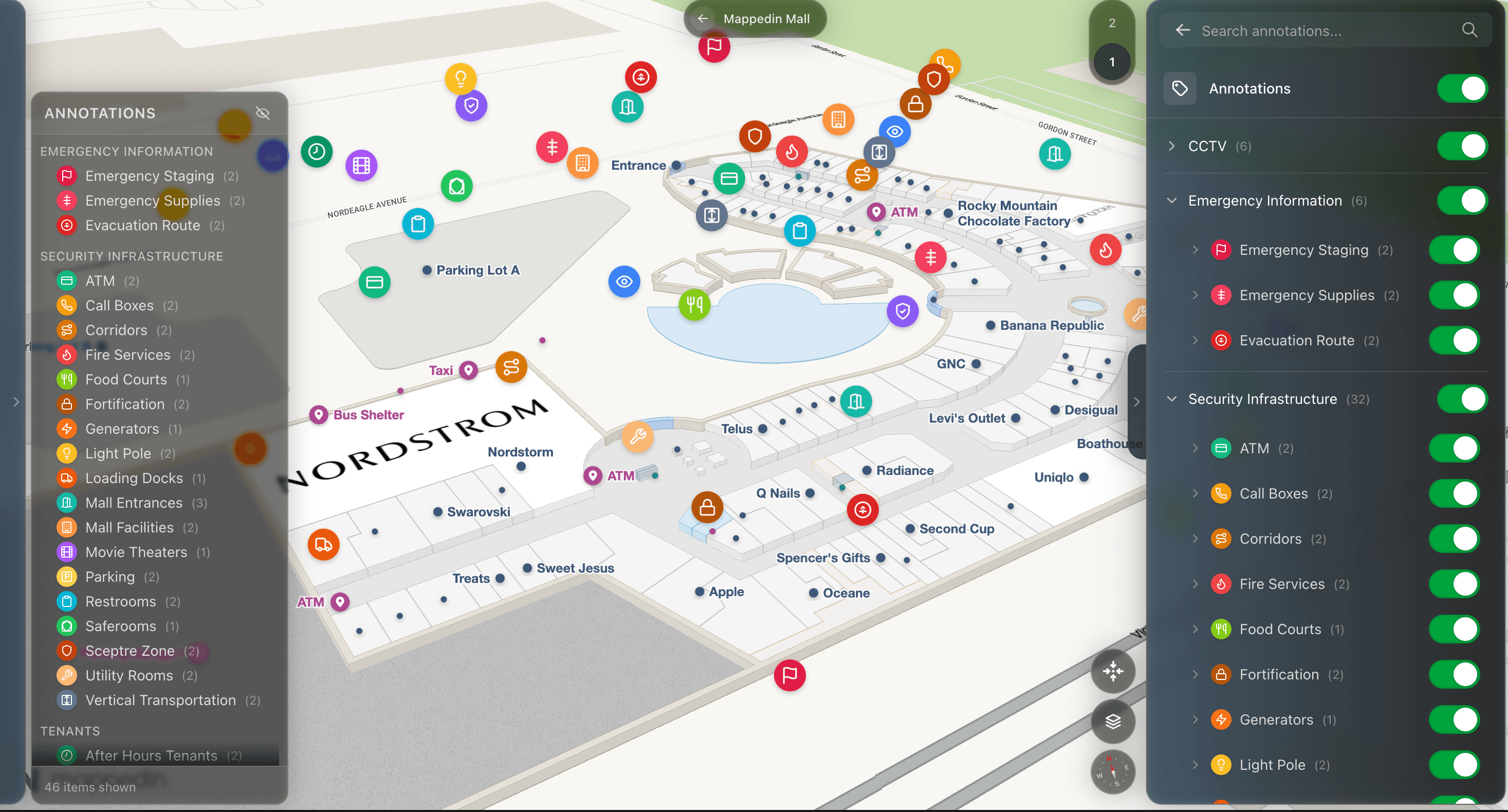
Mappedin's platform is built to serve both functions from a single map layer. The same spatial data powering fan navigation supports security teams for crowd management and emergency response, operations leads for access control and staff routing, and first responder teams who need accurate floor plans in critical moments.
Peer-reviewed research found that stampede incidents at stadiums have caused 23 major accidents and at least 1,380 deaths globally over 100 years. For stadiums managing large-scale events, a wayfinding platform that connects fan experience and emergency operations is infrastructure.
Mappedin's white-label architecture ensures that all of this stays on your domain, under your brand — something that matters to stadium operators who've evaluated fan engagement platforms that host the experience on their own product.

PAM
PAM is a fan engagement and venue platform serving professional sports organizations. It combines mobile venue navigation with fan loyalty, ticketing integration, and in-venue content delivery — positioning itself as a full-featured fan super-app for sports venues.
Key features
- Mobile venue maps and in-app navigation
- Fan loyalty and rewards integration
- Ticketing and access control tie-ins
- In-venue content, offers, and promotions delivery
PAM might be a good fit if...
PAM is a strong option for franchises that want a turnkey fan engagement platform and are comfortable centralizing fan experience within PAM's own product ecosystem. Its loyalty and content tools go beyond basic wayfinding.
PAM might not fit well if...
PAM's approach means the fan experience lives within PAM's branded environment rather than fully on the stadium's own domain and app. For operators who require white-labeled control (i.e., keeping everything under the venue's brand and within the team's own digital channels) this is a meaningful constraint.
PAM's map maintenance model also involves more vendor dependency than platforms like Mappedin, where stadium teams manage updates themselves.
Pointr
Pointr is an indoor positioning platform that combines indoor positioning, maps, and analytics, with a particularly strong presence in airports and large-format retail environments. Its technology stack includes AI-driven positioning that can work across different hardware configurations.
Key features
- AI-powered indoor positioning (hardware-optional configurations available)
- Interactive maps and turn-by-turn navigation
- Indoor analytics and foot traffic data
- SDK for custom application integration
Pointr might be a good fit if...
Pointr is a credible option for multi-venue organizations with development resources and a need for sophisticated positioning analytics. Its airport and transit deployments demonstrate enterprise-scale capability.
Pointr might not fit well if...
Pointr's product orientation skews toward operational analytics and infrastructure-heavy enterprise deployments. Stadium guest services teams typically need fast, self-serve map management and consumer-grade fan UX more than positioning infrastructure.
The platform's implementation complexity and developer-first SDK model can be barriers for fan experience teams without dedicated technical resources.
MapsPeople (MapsIndoors)
MapsPeople is an indoor mapping platform that primarily operates through its MapsIndoors SDK, enabling developers to embed indoor navigation into their own applications. It serves a broad range of verticals including corporate campuses, healthcare, and airports.
Key features
- Maps Indoors SDK for custom application development
- Google Maps and Apple Maps outdoor-to-indoor handoff
- CMS for map content management
- Room booking and space management integrations
MapsPeople might be a good fit if...
MapsPeople is well-suited for organizations with strong development resources that want to build highly customized indoor navigation experiences. Its SDK gives technical teams significant flexibility and deep integration options.
MapsPeople might not fit well if...
The developer-first model creates a higher implementation burden for stadium guest services teams without dedicated engineering resources.
Out-of-the-box fan experience tools require significant configuration, and MapsPeople's stadium reference base in North America is thinner than platforms built specifically for live entertainment venues. Revenue and sponsorship tools are not a core part of the product offering.
Getting started with sports stadium wayfinding
Concept3D built its reputation in higher education, and for universities focused on admissions marketing, it does that job well. But for stadium and arena operators who need wayfinding to work on game day, it might not be the best choice.

Mappedin is the strongest alternative for the commercial stadium context. It gives guest services teams self-serve map control, delivers beacon-free blue-dot navigation at scale, generates measurable sponsorship value, and connects fan experience to operational infrastructure on a white-labeled platform that stays entirely on the venue's domain.
Ready to see what stadium wayfinding looks like on a platform built for game day and beyond? Book a Mappedin demo →
Share