

A tenant calls to complain that their holiday hours are wrong on the directory — again. A shopper posts on social media that the map sent them to a store that closed three months ago. The marketing team spends two weeks coordinating static map updates across a dozen properties, only to start the cycle over when the next lease change hits.
This is the reality for most mall operators still running legacy directory systems. And the cost is not abstract.
They can't locate a store, find a restroom, or figure out how to move between floors. Each of those failures erodes the trust that keeps shoppers coming back. The question for portfolio-level mall operators in 2026 is not whether to have a digital directory. It is whether your current approach can stay accurate at scale without constant manual intervention—and whether it is doing anything beyond showing a pin on a map.
A modern mall directory goes beyond wayfinding. The best mall directories are tenant engagement infrastructure, advertising platforms, and accessibility tools rolled into one. The platforms that understand this distinction are the ones worth evaluating.
What separates a modern mall directory from a static map tool
Before comparing specific platforms, it helps to define what a mall directory needs to do in 2026.
Self-service CMS with real-time updates
The single biggest operational pain for portfolio operators is keeping directory content accurate across properties. When a tenant changes hours, opens a pop-up, or closes permanently, how fast can one person push that update across every touchpoint (i.e., kiosk, web, mobile) without filing a developer ticket? If the answer is "days" or "it depends," the system is creating work instead of eliminating it.
Tenant engagement tools
A directory that only shows locations is a map. On the other hand, a directory that surfaces deals, events, promotions, and rich tenant profiles (galleries, social links, hours, descriptions) gives shoppers a reason to browse and gives tenants a reason to care about the platform. Without this, tenant participation stays low and the directory feels like a utility rather than a channel.
Advertising and sponsorship monetization
Banner ads, sponsored listings, and full-screen overlays turn a directory from a cost center into a revenue channel. For a VP of Marketing managing sponsorship relationships, the ability to offer measurable digital placements inside the venue's own navigation experience is a concrete selling point. Platforms without monetization tools leave that revenue on the table.

Multi-property scalability
Managing 10 properties should not require 10 times the effort. Portfolio operators need a single platform that handles data syncs, content templates, and property-level customization without duplicating setup work at every location.
Localization and accessibility
WCAG compliance, multi-language support, and step-free routing are legal and ethical requirements in 2026. A directory that cannot serve visitors who use screen readers, speak a different language, require other forms of mobility is incomplete.
Integration flexibility
The directory must embed into existing apps, kiosks, and websites without requiring a rebuild. Most malls already have a digital ecosystem. The directory needs to work within it, not replace it.
Each of these criteria maps directly to a business outcome: revenue generated, operational hours saved, tenant satisfaction maintained, or compliance risk mitigated. The platforms reviewed below are evaluated against all six.


Mappedin: Built for commercial venue portfolios
Mappedin Directory is purpose-built for commercial venues like malls and large retail portfolios, designed around the specific needs of operators managing multiple properties at scale.
Content management system
serves as a single source of truth for every property in a portfolio. When a tenant listing changes, the update propagates in real time across every touchpoint — web directories, kiosks, and embedded app views — without developer involvement. For operators managing dozens or hundreds of properties, this eliminates the cyclical rebuild problem that makes legacy directories so expensive to maintain.
Tenant engagement and monetization
The platform includes built-in deal and event promotion, rich tenant profile cards (with galleries, hours, social links, and descriptions), banner advertising, full-screen ad overlays, and sponsored listings. Mappedin Directory is designed to turn the directory into a revenue-generating channel for marketing and sponsorship teams.

Foundational accessibility
Mappedin supports 40+ languages, meets WCAG 2.1 AA accessibility standards, and offers step-free routing and screen reader compatibility. The platform uses AI-powered map creation and infrastructure-free indoor positioning, removing the hardware dependency that adds cost to competing solutions.
Proof of portfolio-scale deployment
Premier property management companies like Simon Property Group manage interactive directories across hundreds of properties with Mappedin. Cenomi Centers, one of the largest mall operators in Saudi Arabia, trust Mappedin as its mapping platform across its portfolio.
— Kurt Ivey, VP of Marketing, Macerich

How other mall directory platforms compare
Four alternatives appear most frequently in mall directory evaluations. Each has genuine strengths and specific gaps relative to the criteria that matter to portfolio-level retail operators.
MapsPeople
MapsPeople offers strong CMS tooling and integrates well with existing tech stacks, including Google Maps. Their platform handles large venue wayfinding well and has a growing presence in workplace and campus environments.
For mall operators, the gap is in tenant engagement depth. MapsPeople's MapsIndoors is oriented more toward navigation and space management than toward deals, events, promotions, and advertising monetization. If your primary need is wayfinding with tech stack integration and your tenant engagement requirements are minimal, MapsPeople is a viable option. For operators who want the directory to function as a marketing and revenue channel, the feature set is thinner.
Compare Mappedin vs. MapsPeople →
Pointr
Pointr is an indoor positioning platform with capabilities in AI-powered positioning and analytics. For venues that prioritize sub-meter blue dot indoor positioning, Pointr's technology is a solid choice.
The tradeoff is that their positioning approach is hardware-dependent, which adds infrastructure cost and deployment complexity. Their retail directory features and tenant engagement tools are less developed than their positioning technology. Overall, Pointr is a better fit for venues buying a positioning platform first and a directory second.
Visioglobe
Visioglobe specializes in 3D mapping and visualization, with strong rendering capabilities used in airports and some retail environments. Their maps are visually detailed, which matters for complex multi-level venues.
However, Visioglobe's directory and tenant engagement capabilities aren't as strong as others on the list. Self-service CMS capabilities are more limited, and out-of-the-box advertising and monetization tools are not a core part of the product.
Visioglobe works well as a mapping visualization layer but requires more custom integration to function as a complete directory solution.
Compare Mappedin vs. Visioglobe →
Abuzz
Abuzz is a newer mall directory software provider focused on smart building and venue engagement, offering interactive directories and analytics capabilities. Their approach to venue intelligence is solid, but their deployment footprint is smaller and public case studies for large mall portfolios are limited. For operators evaluating proven portfolio-scale solutions, Abuzz has less track record to reference.
Frequently asked questions
What is the difference between a digital directory and an indoor navigation system?
A digital directory shows visitors what is in a venue, including store listings, hours, deals, events, and categories. An indoor navigation system provides turn-by-turn wayfinding to get them there. Modern platforms like Mappedin combine both into a single product, so visitors can search for a store and immediately get directions. Some platforms focus on one or the other, which can mean stitching two systems together.
How much does a mall directory system cost?
Pricing varies significantly based on the number of properties, deployment type (web, kiosk, app embed), and feature requirements. Most vendors price per property or per portfolio with annual contracts. Expect to evaluate total cost of ownership—including map creation, CMS maintenance, and content management labor—not just the license fee. Request pricing from shortlisted vendors with your specific property count and feature needs.
Can a digital directory generate advertising revenue?
Yes. Platforms with built-in advertising tools allow mall operators to sell banner placements, sponsored listings, and full-screen ad overlays to tenants and external brands. This turns the directory from a cost center into a measurable revenue channel. The revenue potential depends on visitor traffic, ad inventory design, and how well the directory is promoted to shoppers.
How long does it take to deploy a digital directory across multiple properties?
Deployment timelines depend on the number of properties, map complexity, and how much existing floor plan data is available. A single property can typically go live in weeks. Portfolio-wide rollouts across dozens of properties may take several months, particularly if floor plans need to be created or updated. Platforms with AI-assisted map creation and data sync tools can compress this timeline significantly.
Do digital directories work on kiosks and mobile devices?
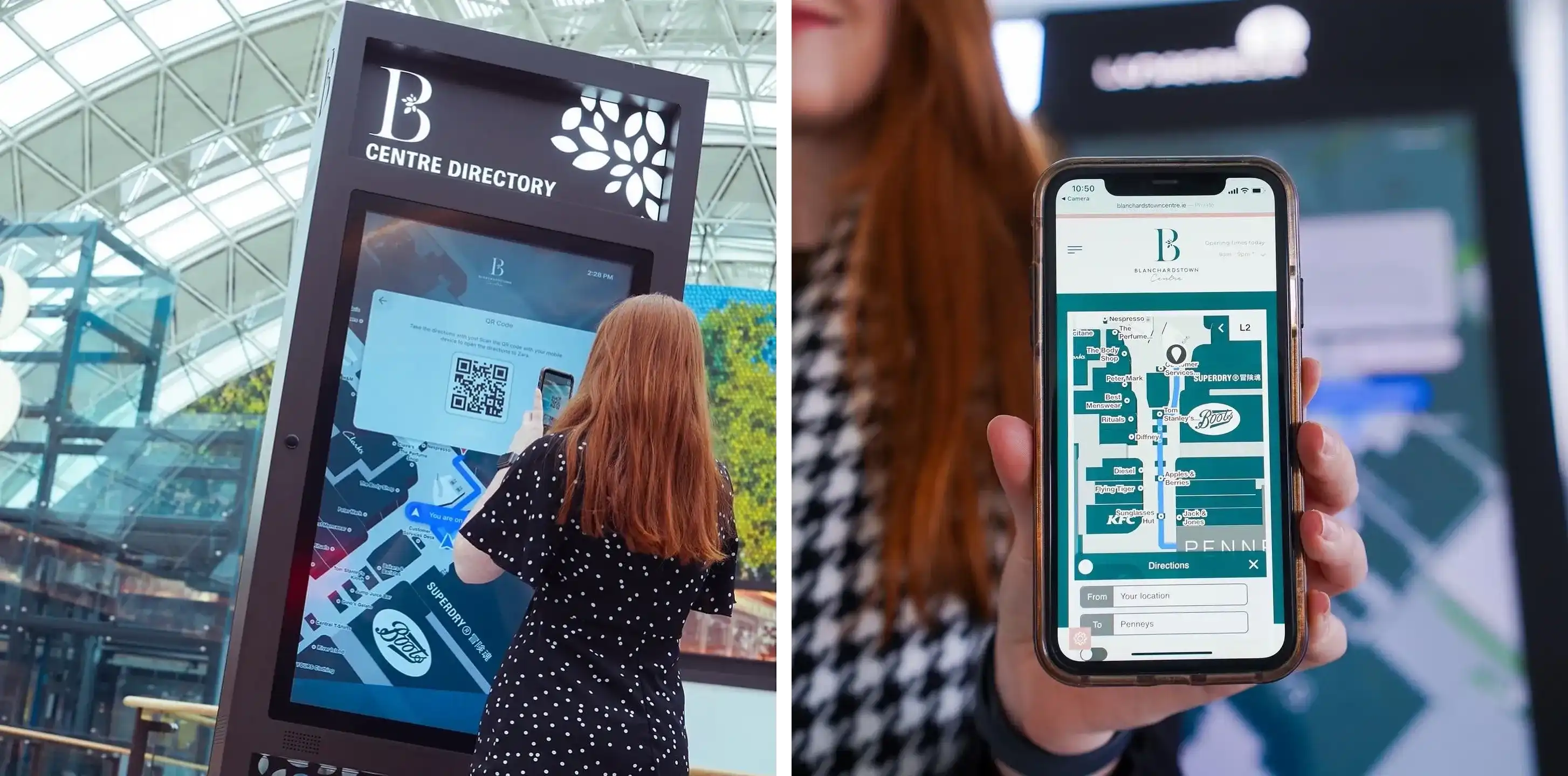
Most modern directory platforms are web-based and work across kiosks, mobile browsers, and embedded app views without requiring separate native apps. This is important for malls because visitors should not need to download anything to use the directory. Kiosk-specific features like larger touch targets and QR code sharing to mobile are available on some platforms, including Mappedin.
How to choose the right mall directory software for your property
When assessing mall directory software, the key is in determining which platform can:
- Stay accurate across your entire portfolio without constant manual effort
- Engage tenants and shoppers beyond a pin on a map
- Generate measurable revenue through advertising and sponsorship placements
For most mall operators, the cost of a lackluster directory experience is real: tenant dissatisfaction when listings are wrong, lost sponsorship revenue that a digital directory could capture, and a visitor experience that falls further behind what shoppers now expect from any physical space they walk into.
The platforms built for retail understand this. The ones that will earn your investment in 2026 are the ones that treat the directory as what it actually is—a revenue, engagement, and operations platform, not just a map.


Share