

Casino resorts are not designed to be easy to navigate. In fact, that's often the point, at least on the gaming floor. Slot banks are arranged to maximize dwell time, sightlines are deliberately broken, and natural light is eliminated to keep guests playing longer. And the venues themselves are sprawling:
- The MGM Grand's gaming floor alone spans 171,500 square feet
- The Venetian and Palazzo complex stretches across 225,000+ square feet of interconnected property.
The problem is that modern casino is no longer just an entertainment and gaming venue. They're multi-use destinations with 20+ restaurants, hotel towers, entertainment arenas, convention centers, retail promenades, spas, pool decks, and multi-level parking garages, often exceeding 100,000 square feet beyond the gaming floor.
Unlike airports, which funnel passengers through a linear flow, or malls, which anchor traffic between department stores, casinos have no obvious navigational spine. The layout that keeps guests at the slot machines is the same layout that causes them to miss their dinner reservation, skip the spa, or abandon a show because they couldn't find the theater in time.
That tension between intentional disorientation on the gaming floor and efficient discovery across the broader resort is a core challenge for guest experience teams.
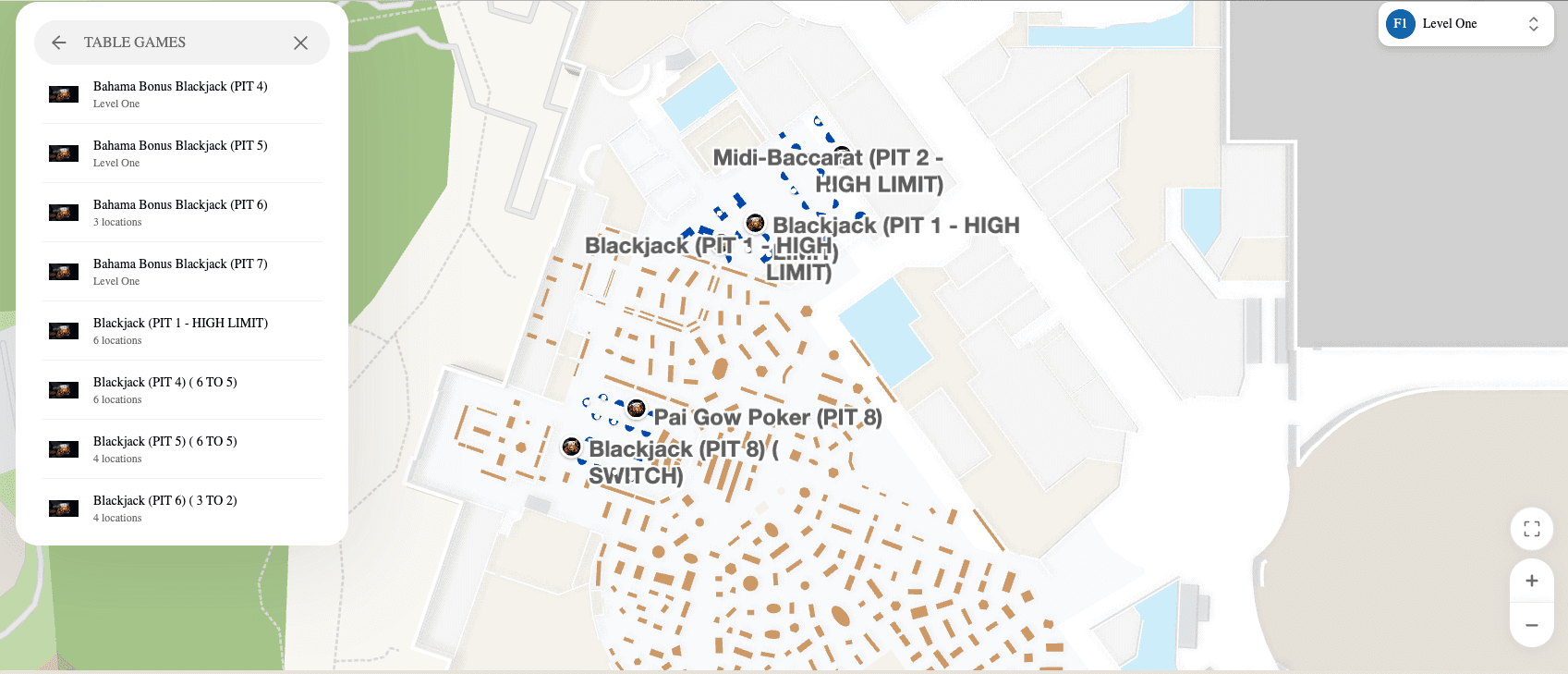
The five friction points guests hit in casinos
According to our recent report, 53% of visitors experience at least one navigation problem per visit in large venues. Casinos compound that number because they layer navigational complexity on top of deliberate spatial confusion. There are five common friction points as a guest explores:
1. Floor confusion across identical environments
The maze-like design that works for gaming retention works against everything else.
Multi-level gaming floors use repeating visual cues like similar carpet patterns, lighting, and slot configurations that make it genuinely difficult for guests to tell which floor or wing they're on. A guest who steps away from a blackjack table to use the restroom can spend minutes trying to relocate the same table.
2. Missed reservations and lost F&B revenue
A guest booking a 7:30 dinner reservation at a steakhouse might plan to leave the gaming floor at 7:15, assuming fifteen minutes is enough to get to where they're going. But it isn't. They arrive late, the table is released, and the property loses revenue.
Multiply this across thousands of guests per week and the revenue impact is felt for the restaurant operator, as well as the casino's own F&B margins.
3. Amenity invisibility
Spas, pool decks, retail shops, and loyalty lounges go chronically underutilized because guests simply don't know they exist or can't find them from the gaming floor. Most casinos still rely on static signage or printed PDF maps to surface these amenities.
Neither format adapts to where the guest is or what they might want based on time of day.
4. Parking and re-entry friction
A guest leaves the gaming floor to grab something from their car in a multi-level garage. Returning to the same area of the property or even finding their car becomes its own ordeal. The re-entry problem is worse than the initial arrival because the guest now has no staff interaction to orient them.
5. Staff burden on directional queries
Front desk staff, concierge teams, and floor hosts spend a disproportionate share of their time giving directions. Every minute spent pointing someone toward a restaurant or explaining how to reach Tower B is a minute not spent on the kind of high-value hospitality interaction that drives guest satisfaction scores and loyalty program engagement.

The hidden revenue casinos are leaving on the table
Casinos are investing billions in restaurants, entertainment, retail, and event space. But if guests can't find those amenities, that investment doesn't pay off. This guide shows Ops and Marketing teams how indoor mapping closes the gap, and what it's worth when it does.
What to look for in a digital wayfinding solution
If you're evaluating digital wayfinding for a casino, five criteria matter more than anything else.
Mobile-first
Casino guests are already on their phones. QR codes and direct links work better than fixed hardware in a 24/7 environment where kiosks get damaged, require constant maintenance, and occupy floor space. Ask any vendor how guests access the map without downloading an app.
Real-time updatability
Casino floors change constantly. The map needs to be a living document that operations teams can update without filing a ticket with IT. If the wayfinding tool can't reflect a floor change within hours, it will go stale and guests will stop trusting it.
Multi-destination routing
Casino guests don't go to one place. They want dinner, then a show, then valet, in that order. Single-destination directions solve a fraction of the problem. The wayfinding system should handle a multi-stop itinerary the way a concierge would.
Amenity discovery built into the map
The map shouldn't just give directions. It should surface deals, loyalty perks, dining options, and entertainment—turning navigation into a discovery tool. This is the difference between wayfinding as a cost center and wayfinding as a revenue driver.
White-label wayfinding experience
The experience should feel like the casino's own brand, not a third-party tool. Guests should never land on another company's domain or see branding that breaks the property's visual identity.
How digital wayfinding reduces costs and lifts guest spend
The operational case for digital wayfinding in casino resorts maps directly to the friction points above.
Reduced no-shows for dining and entertainment
When guests can route directly to a restaurant from anywhere on property, reservation capture improves. The gap between booking and showing up is where revenue leaks, and wayfinding closes it.
Increased ancillary spend
When a map surfaces the spa, a retail promotion, or a loyalty lounge that a guest didn't know existed, per-visit spend outside the gaming floor goes up. Venues with similar navigational complexity have already proven this.
For example, St. Louis CITY SC, a stadium with 375,000 fan sessions mapped through digital wayfinding, saw a 150% food sales lift when the platform surfaced new food partners alongside navigation.
Staff reallocation
Redirecting even 15–20% of directional queries from concierge and floor staff to self-serve digital wayfinding frees those team members for hospitality interactions that actually move satisfaction scores. Airports and stadiums operating at comparable scale have demonstrated this shift consistently.
How Mappedin improves casino guest experience with digital wayfinding
Mappedin is an indoor mapping and wayfinding platform trusted by the world's most complex, premier venues across retail, hospitality, entertainment, transportation and more.
Casinos use Mappedin's mobile-optimized web app and kiosk software to power better guest experiences. With Mappedin, operations teams can update floor layouts, restaurant hours, and event spaces in real time without developer support.
— Rachel Bell, VP of Client Development, Product at Intersection, Hudson Yards
Multi-destination wayfinding handles the dinner-to-show-to-valet routing that casino guests actually need. And built-in deals, events, and directory features turn the map into a discovery and monetization tool, not just a set of directions.
Mappedin supports 40+ languages and meets WCAG 2.1 AA accessibility standards, which matters for properties serving international visitors and meeting compliance requirements.


Share