Start Here
Mappedin AI Navigator is a geo-intelligence engine that combines agentic AI, real-time data, and location awareness to optimize operations and visitor experience at scale. AI Navigator closes the profitability gap by delivering real-time multilingual guidance across flight updates, security wait times, parking, and amenities with built-in accessibility features, including voice instructions and screen reader compatibility. Deployed through Azure or AWS integration, this intelligence layer empowers visitors and staff with adaptive insights that reduce decision latency, increase dwell-time spending, and transform airport infrastructure into revenue opportunities.
Airports have become intelligent ecosystems. Among the most complex environments in the world, every movement, message, and moment generates context. For airport leaders, that context only becomes valuable when it can be collected, understood, and acted on in real time.
Mappedin AI Navigator gives airport operators and staff a unified, real-time understanding of their venues, serving as an intelligence layer that combines agentic AI, geo-awareness, and live data to connect infrastructure, systems, and people in motion. With this intelligence at their command, airports can predict demand, adapt operations, and deliver precise information through the right channels, at the right time, in the right places. Seamlessly integrated into enterprise systems, AI Navigator turns location intelligence into adaptive insight, enabling operators to anticipate and respond confidently to both operational needs and passenger expectations.
Designed for experience, efficiency, and scale, Mappedin provides the intelligence engine airport leaders use to deliberately shape the new airport experiences.
The airport growth-profitability gap
Global air travel has rebounded to record levels, with more than 9.4 billion passengers passing through airports in 2024—an 8.4% increase from the previous year. Yet, despite rising volumes, non-aeronautical revenue per traveler has fallen nearly 5% annually since 2015, exposing a widening gap between passenger volume growth and profitability. Physical infrastructure alone can’t close the gap; digital intelligence must.
At the same time, the airport systems market, valued at USD 31.5 billion, is expanding at 8% CAGR, and the airport digitalization market is projected to double by 2031. Nearly 90% of airport operators plan to increase IT investments, yet fewer than half are satisfied with current systems. The message is clear: modernization is underway, but legacy tools can’t keep pace with operational complexity or traveler expectations.
The challenge now extends beyond moving passengers to optimizing an interconnected ecosystem for engagement, inclusivity, efficiency, and revenue.”
— Yuval Kossovsky, Managing Director of Transportation
Solving high-stakes inefficiencies
Every minute of inefficiency carries real cost—about USD $100 per minute in delay for U.S. carriers—and the pressure to maintain control amid change has never been higher. Passengers demand clarity and confidence; 67% rely primarily on signage for navigation, and research shows that those who feel informed spend significantly more during dwell time. Add to this a growing expectation for inclusivity—88% of travelers say accessibility improvements are “very important”—and the stakes for innovation become undeniable.
Mappedin AI Navigator meets this moment. By combining agentic AI, geo-awareness, and real-time intelligence, it helps airports and passengers adapt in context, turning data into timely decisions, and passenger movement into meaningful opportunity.
The innovation imperative
For airport leaders, innovation is no longer optional or experimental. It’s a daily operational mandate tied directly to performance, resilience, and public trust. Airports are no longer just transit points; they are global experiences. To compete, they must deliver journeys that feel effortless, personalized, and inclusive.
The challenge is in addressing these pressures simultaneously within an ever-changing, live operating environment. Innovation today must solve three pressing challenges:
- Complexity: Passengers and staff need clarity in real time.
- Inclusivity: Accessibility and equity are mission-critical requirements.
- Scalability: Technology must integrate seamlessly with existing systems.
Addressing this level of venue complexity requires an intelligence layer purpose-built to support airport leadership, staff, and passenger decisions at scale. Mappedin AI Navigator addresses all three, setting a new industry benchmark.
True agentic AI for passenger engagement
In modern airports, decision latency, not data availability, is the true constraint on performance. At the core of AI Navigator is true agentic AI, an intelligent system that acts like an intelligence exoskeleton, reducing stress, accelerating decisions, and empowering both passengers and employees.
Airport leaders need situational awareness that reflects what and where things are happening now, not after the fact, across the entire passenger journey. AI Navigator dynamically aggregates real-time data from:
- Flight updates and gate changes
- Security wait times
- Parking availability
- Duty-free and retail promotions
- Airport websites and amenities
- Map routes, exclusions, and destinations
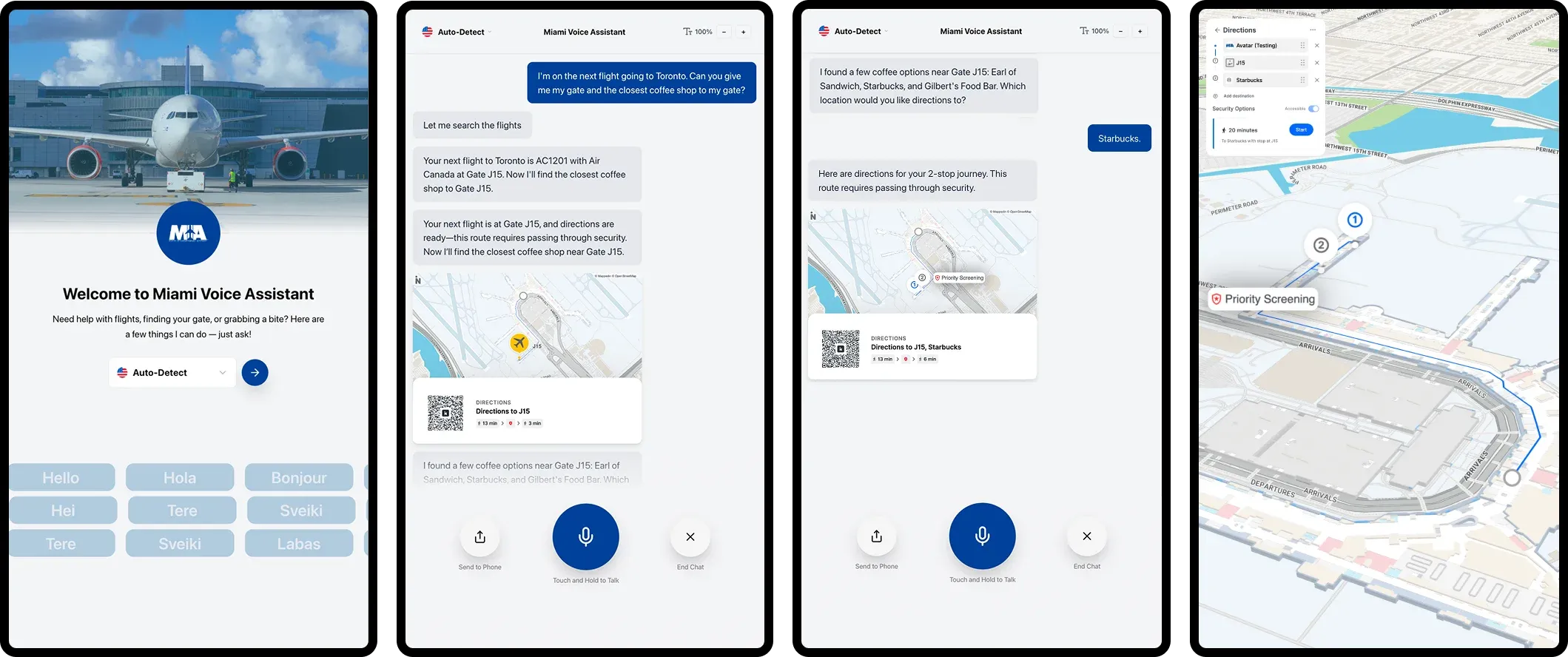
With built-in geo-intelligence for airports, Mappedin AI Navigator understands context—locations, distances, directions, movement, and availability—to provide adaptive, personalized responses. It communicates in any language, instantly bridging communication barriers.
The result goes beyond passenger engagement to measurably reducing friction, faster operational response, and greater confidence for both travelers and frontline teams.
Inclusivity by design
Innovation is incomplete without inclusive accessibility. For airports, inclusive design is a top strategic imperative that affects compliance, brand trust, operational consistency, and the ability to serve every traveler at scale.
With Mappedin, accessibility isn’t an add-on; it’s a core innovation principle.
Built to ensure every traveler, regardless of ability or need, solutions help passengers navigate with ease using:
- Voice instructions: Clear, spoken guidance supports passengers with visual impairments or those who prefer auditory directions.
- Sensory-friendly maps: Designed with simplicity and clarity, reducing stress for travelers with autism, ADHD, or cognitive differences.
- Adaptive access: Automatically respects a passenger’s phone accessibility settings for consistency and comfort.
- Screen reader compatibility: Ensures inclusive delivery of all information across devices.
Airport-ready: Scale, agility, accountability
Airports demand solutions that innovate without compromising security or control. Any intelligence layer operating at airport scale must strengthen governance, not dilute it.
Airport innovation succeeds only when it works within the operational reality. That’s why Mappedin works hand-in-hand with airport leaders to ensure AI Navigator integrates flexibly within existing systems, policies, and performance expectations by offering:
- Azure or AWS integration: Built to leverage the full security, compliance, and scalability of your existing infrastructure.
- Your AI, on your terms: Operates using your version of the OpenAI contract, giving airports direct control over costs and compliance.
- Hardware flexibility: Deployed seamlessly across kiosks, signage, mobile apps, hologram projectors, or staff devices—ensuring consistent access at every touchpoint.
- Data integration: Designed for flexible, real-time data connectivity to unify core operational systems, delivering instant visibility, insights, and enterprise-scale performance.
Passenger + employee applications
Innovation must serve the entire ecosystem. Sustainable innovation requires balancing passenger experience with employee effectiveness, optimizing one without the other only shifts friction elsewhere.
- Passenger-facing: Real-time guidance, multilingual engagement, accessibility-first design.
- Employee-facing: AI-powered insights, live operational overlays, and contextual guidance, freeing staff to focus on delivering friendliness, empathy, and service.
Serving the airport ecosystem as a mission-critical ‘intelligence exoskeleton’, AI Navigator doesn’t replace people. It gives them vital knowledge and context that makes them more capable, confident, and connected.
Mappedin helps you lead the way
Airport leaders have seen maps, data services, and digital assistants before, but rarely as a single, integrated intelligence layer designed for real-world operations. Mappedin uniquely provides:
- Sophisticated, data-enriched map look-and-feel: Polished, intuitive, trusted worldwide
- Industry-leading real-time data services: Dynamic overlays and intelligence ahead of the competition.
- Complete AI-powered ecosystem: Designed to augment human capability, not just add features.
What sets this approach apart is not any single capability, but the way intelligence, location, and decision-making converge into shared infrastructure. Mappedin AI Navigator is a new category of venue experience where infrastructure becomes intelligence, and every journey is powered by data, insight, and design.
The future of travel, defined
The airport of the future isn’t just about moving people from point A to B. It’s about making the entire journey, A to Z, clear, inclusive, and human.
Mappedin AI Navigator applies innovation with purpose: reducing complexity, increasing inclusivity, and empowering operators, staff, and travelers. It redefines how people move through the most demanding travel environments in the world.
The future of airport leadership will be defined by how effectively intelligence is translated into action, across venues, systems, and the moments that matter most.

Share