

Start Here
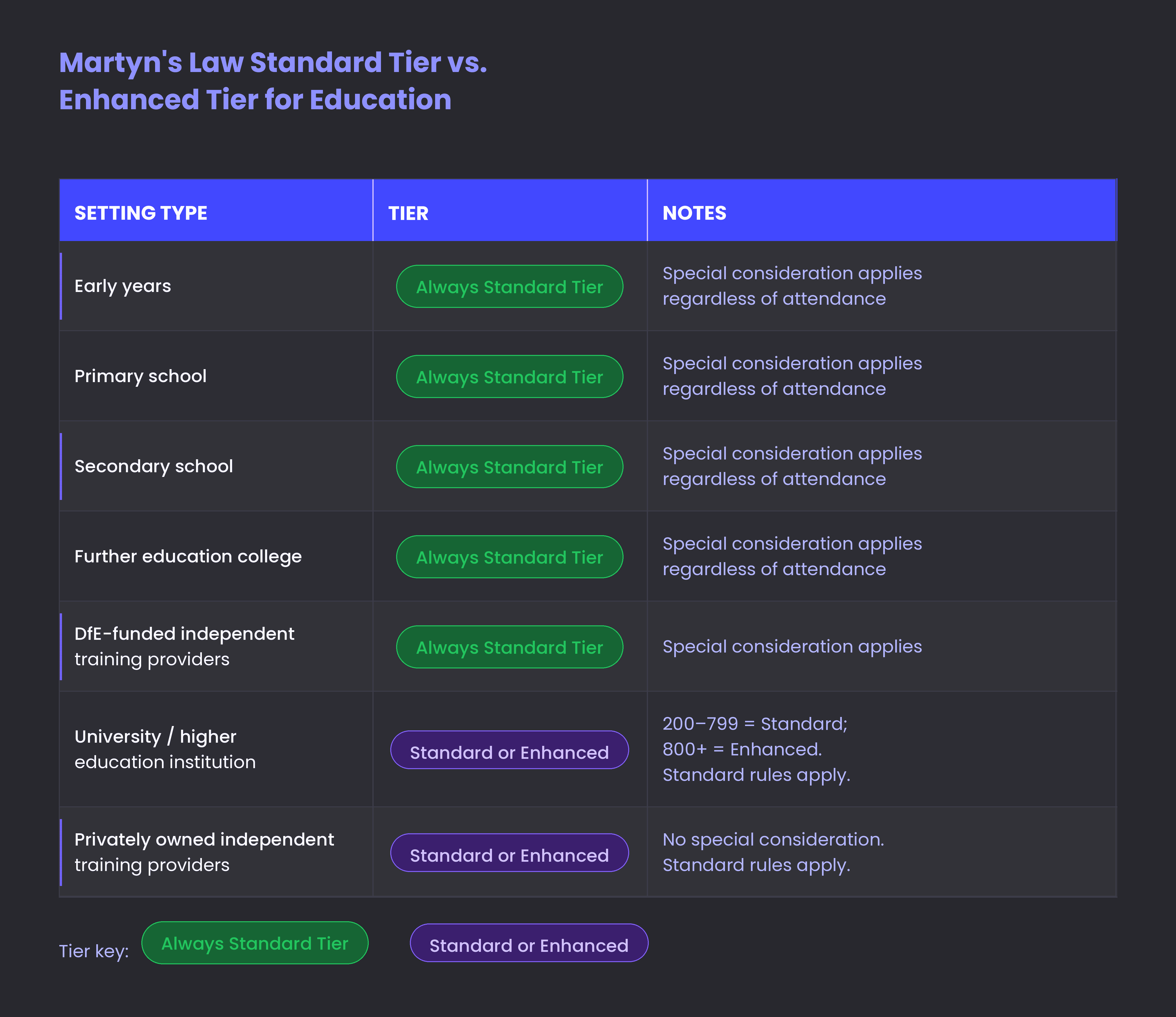
Under Martyn's Law, all early years, primary, secondary, and further education settings are automatically classified as Standard Tier, regardless of how many pupils or staff they have. They are required to have public protection procedures in place covering evacuation, invacuation, lockdown, and communication before the Act comes into force.
Think about the last time your school hosted a parents' evening, a school play, or a sports day where families filled the bleachers. In those moments when staff, pupils, and visitors are all on site together, you may well have crossed the threshold that brings Martyn's Law into effect.
For most schools, that threshold is not rare, but a weekly occurrence.
Martyn's Law, formally the Terrorism (Protection of Premises) Act 2025, is the UK's first law to establish a legal baseline for counter-terrorism preparedness at public venues, and education settings are in scope. The question most school leaders, safeguarding leads, and facilities managers are now asking is “what does that actually mean for us?”
The short answer is less daunting than it might initially sound. Education settings receive special treatment under the Act. The requirements are procedural, not physical. And the implementation period (at least 24 months from April 3, 2025) gives schools time to prepare properly if they get started now.
This guide explains:
- What the Act requires specifically for education settings
- What's different about schools compared to other venue types
- Where to start
It draws directly on the Department for Education's policy paper How Martyn's Law will affect education settings (updated October 2025) and the Home Office Martyn's Law Factsheet (updated April 2026).
This guide is not legal advice. For guidance specific to your organization, consult the official statutory guidance or a qualified professional.


Does Martyn's Law apply to schools?
The short answer is yes. But it’s with a specific and significant carve-out that makes education settings different from almost every other type of qualifying premises.
The Act applies to premises that meet four criteria:
- There is at least one building
- It is used for a Schedule 1 qualifying purpose
- It is reasonable to expect 200 or more individuals present at the same time
- It is not excluded under Schedule 2
Education is a Schedule 1 use, meaning schools, colleges, and universities that expect 200 or more people including staff and learners are in scope. What makes education settings distinctive is what happens next.
The Standard Tier cap for schools
All early years, primary, secondary, and further education settings have a special consideration in place under the Act. This means they will be in the Standard Tier even if they expect 800 or more individuals to be present.
Enhanced Tier requirements will not apply to premises used for early years, primary, secondary, or further education.
This matters enormously in practice. Without this carve-out, any school or college expecting 800+ people (applicable to many secondary schools, sixth form colleges, and large primaries on event days) would face the full Enhanced Tier obligations:
- Physical measures
- SIA documentation
- A designated senior compliance individual
- Ongoing review requirements
The Act explicitly removes that burden.
The government's reasoning, as reflected in the Department for Education (DfE) guidance, is that education settings already operate within robust safeguarding and security frameworks. Martyn's Law builds on what exists rather than imposing a parallel system from scratch.
DfE-funded independent training providers fall under the same special consideration and will always be Standard Tier. Privately owned independent training providers, however, do not — they are treated the same as any other qualifying premises, with their tier depending on expected attendance.
Which education settings are Standard Tier vs Enhanced Tier under Martyn's Law?
Settings with fewer than 200 people
Settings that can reasonably expect below 200 individuals to be present do not fall within the scope of the Act.
However, the DfE encourages all settings to have preparedness plans in place for the safety of their learners and staff, whether or not they are legally required to. For smaller schools, the implementation period is a useful moment to consider basic emergency planning regardless of the legal threshold.
When Martyn's Law applies even to smaller schools
Here is the aspect of Martyn's Law that many school leaders initially overlook, and that has the most practical day-to-day relevance.
A school that operates below 200 people on an ordinary school day can still fall under Martyn's Law when it hosts events.
The threshold is based on how many people it is reasonable to expect to be present at the same time, and that count includes staff, pupils, and visitors.
Events like parents' evenings, school plays, award ceremonies, and sports days regularly push combined attendance above 200 at schools that wouldn't normally meet the threshold. And under Martyn's Law, if 200 or more people are expected, the requirements apply to that event.
For schools that already meet the 200-person threshold during normal operation, this doesn't change much. But it does mean that emergency procedures need to account for the different layouts, visitor flows, and unfamiliar-with-the-building populations that events bring with them.
A lockdown procedure designed for a normal school day may not work the same way when the hall has been reconfigured for a production and a hundred parents are in the building.
What does Martyn's Law require schools to do?
Standard Tier requirements are, by design, achievable without significant capital expenditure. There is no requirement to install CCTV, physical barriers, or access control systems. There are no mandatory bag searches.
The focus is entirely on having plans that staff can carry out without additional expense because that, more than any physical infrastructure, is what determines how a school responds when something goes wrong.
The Act requires two things of Standard Tier premises:
- Notify the SIA
- Have appropriate public protection procedures in place
Notifying the SIA
When the Act comes into force, the responsible person for a qualifying premises must notify the Security Industry Authority (SIA) as the regulator.
For most education settings, the responsible person is the person who has control of the premises in connection with its Schedule 1 use. For a primary school, this will typically be the governing body or, where there is no governing body, the proprietor of the institution.
The four public protection procedures
All education settings within scope must have appropriate procedures in place, so far as is reasonably practicable, for each of the following four categories. These must be tailored to the specific setting – its layout, its staff, the age and needs of its pupils, and the nature of activities taking place there.
Evacuation
Evacuation is getting everyone safely out of the premises. Most schools already have fire evacuation procedures, but Martyn's Law asks a more specific question:
Are those procedures also appropriate for a terrorism scenario?
In some situations, e.g., an attack outside the building, an incident in another part of the site, getting out may not be the safest option. The evacuation procedure needs to account for that distinction:
- When to evacuate
- Which routes to use
- How to communicate that instruction to staff, pupils, and visitors across every part of the site
The practical test is whether every member of staff could execute the procedure from wherever they happen to be when an alert is raised, not just from the main reception.
Invacuation
Invacuation is moving people to a safer location inside the building when leaving is not safe. This is the procedure most schools have thought least about, yet in many terrorism scenarios, it’s the most important.
Invacuation requires more than knowing that a safe room exists somewhere in the building. It requires staff to know:
- Which rooms are appropriate
- How to get to them from every part of the site
- How to communicate that route clearly to pupils and visitors who may be unfamiliar with the building
Think about a parents' evening where families are spread across multiple classrooms, the school hall, and the car park. If something happens in the surrounding area that makes leaving unsafe, does every staff member on duty know exactly where to take the people near them, and how to get there? For schools with complex layouts—multiple buildings, large sites, temporary structures for events—this is the procedure most likely to expose gaps in a school's current emergency planning.

Lockdown
Lockdown is securing the premises to prevent people entering or leaving. Most schools in the UK have developed some form of lockdown procedure, particularly since high-profile incidents internationally raised awareness of the need; Martyn's Law formalises that obligation in UK law.
A lockdown procedure should identify which doors, shutters, or barriers to secure, in what sequence, and who is responsible for each. It should also account for the parts of the site that are hardest to secure quickly (examples: sports fields, temporary entrances, external teaching areas).
The statutory test that procedures must be implementable "rapidly and effectively" applies here as much as anywhere. A lockdown procedure that requires staff to remember a long sequence of steps they've never practiced under pressure is not the same as one they've drilled until it's automatic.
Communication
Communication is alerting staff, pupils, and visitors to danger and providing clear instructions in real time.
This covers both the internal system and the outward communication:
- What do pupils do?
- What do visiting parents do?
- What do contractors on site do?
Vague instructions are harder to follow under stress than specific, spatially grounded ones. For example, "move to safety" is harder to act on than "move to the main hall via the east corridor and wait for further instructions." The more specific the instruction, the more likely it is to be followed correctly by people who are frightened.
The "rapidly and effectively" test
The Act sets a specific standard: procedures must be implementable "rapidly and effectively."
A written procedure that staff haven't read, haven't practiced, or that assumes knowledge of the building they don't have, does not meet the standard. The preparation question for every school is whether staff have that information readily available, or whether they'd be working it out as an incident unfolds.
What about universities and higher education?
Universities and higher education institutions do not benefit from the Standard Tier cap that applies to schools and FE colleges. They are assessed as standard qualifying premises, with their tier determined by expected attendance:
- 200–799 people expected: Standard Tier; SIA notification and four public protection procedures required
- 800 or more people expected: Enhanced Tier; all Standard Tier requirements, plus physical protection measures across four categories, documentation submitted to the SIA, and a designated senior compliance individual
For university security and facilities teams, the Enhanced Tier obligations represent a significant operational commitment. Open campuses, high public footfall, multiple buildings, and complex access control arrangements all make the requirement to document measures and "keep them under review" a sustained operational discipline rather than a one-time exercise.
How schools can prepare for Martyn's Law during the implementation period
The government intends for there to be an implementation period of at least 24 months from April 3, 2025 before the Act comes into force. That is valuable preparation time, and the schools that use it well will find compliance far more straightforward than those that wait.
The good news – most schools are closer to compliance than they think. The Act builds on frameworks many schools already have in place. The work is largely about reviewing what exists, identifying the gaps, and making sure procedures are genuinely executable, not just documented.
Step 1: Audit what you already have
Map your existing emergency procedures against the four required types. Fire evacuation plans, lockdown protocols from existing safeguarding reviews, communication systems already in use — most schools have the building blocks. The question is whether they are fit for a terrorism scenario, not just for the situations they were originally designed for.
Identify what exists and is current, what exists but needs updating, and what's genuinely missing. For most schools, the biggest gap will be invacuation — followed by communication procedures that account for visitors and events, not just the regular school day.
Step 2: Walk your building with procedures in hand
This is the step most schools skip, and yet it’s the one that reveals the most.
Walk every area of the site: classrooms, halls, sports facilities, temporary structures, car parks. For each area, ask: if I needed to move everyone here to safety right now, could I tell every staff member on duty exactly what to do?
Pay particular attention to invacuation. Walk the routes, check the safe rooms, and identify the areas where your current plans assume spatial knowledge that a member of supply staff, a student teacher, or a duty parent helper would not have.
Step 3: Think about your events separately
Review each event on the school calendar where attendance could reach 200. Don't assume that your normal-school-day procedures translate directly.
Events introduce different variables: temporary layouts, unfamiliar visitors, changed access points, reduced staff ratios relative to the number of people on site. For each major event, ask:
- Do our procedures account for this layout?
- Do the staff on duty that evening know them?
- Have we briefed the visitors in any way?
Step 4: Use free government resources
The DfE and Home Office have produced free, education-specific resources designed for this purpose. Take advantage of these resources when planning:
- ACT for Education e-learning — free counter-terrorism awareness training specifically adapted for education settings, available through ProtectUK.
- DfE Protective security and preparedness guidance for education settings — includes a self-assessment template.
- ProtectUK ACT Awareness e-learning — broader counter-terrorism training for frontline staff.
- DfE lunch-and-learn webinars — the DfE is running free sector briefings during the implementation period.
Final thoughts on Martyn's Law for education settings
Martyn's Law exists because of what happened at Manchester Arena on in May 2017. Twenty-two people were tragically killed at a venue where thousands of families, including many children, had gathered for an evening out.
While schools are not concert venues, they are precisely the kind of place this law was written for: public spaces where people gather, where children are present, and where the duty to protect those inside has always been a serious obligation.
What Martyn's Law asks of Standard Tier schools is not radical. It asks for procedures that staff can execute, and plans that account for the real layout of your building.
Most of that work is already within reach. The implementation period is the time to do it properly.
At Mappedin, we work with venues, campuses, and public safety organizations on the challenge of knowing your building well enough to act without hesitation in an emergency. If you're thinking about what that means for your school's or university's preparedness, reach out to us today.


Download A Physical Security Leader's Guide to Indoor Intelligence
Your VMS, PSIM, and patrol platforms all work. But none of them can tell an operator which floor, which corridor, or which camera is actually covering an incident right now. This guide gives Security teams a concrete framework for evaluating the spatial layer your stack is missing.
Share