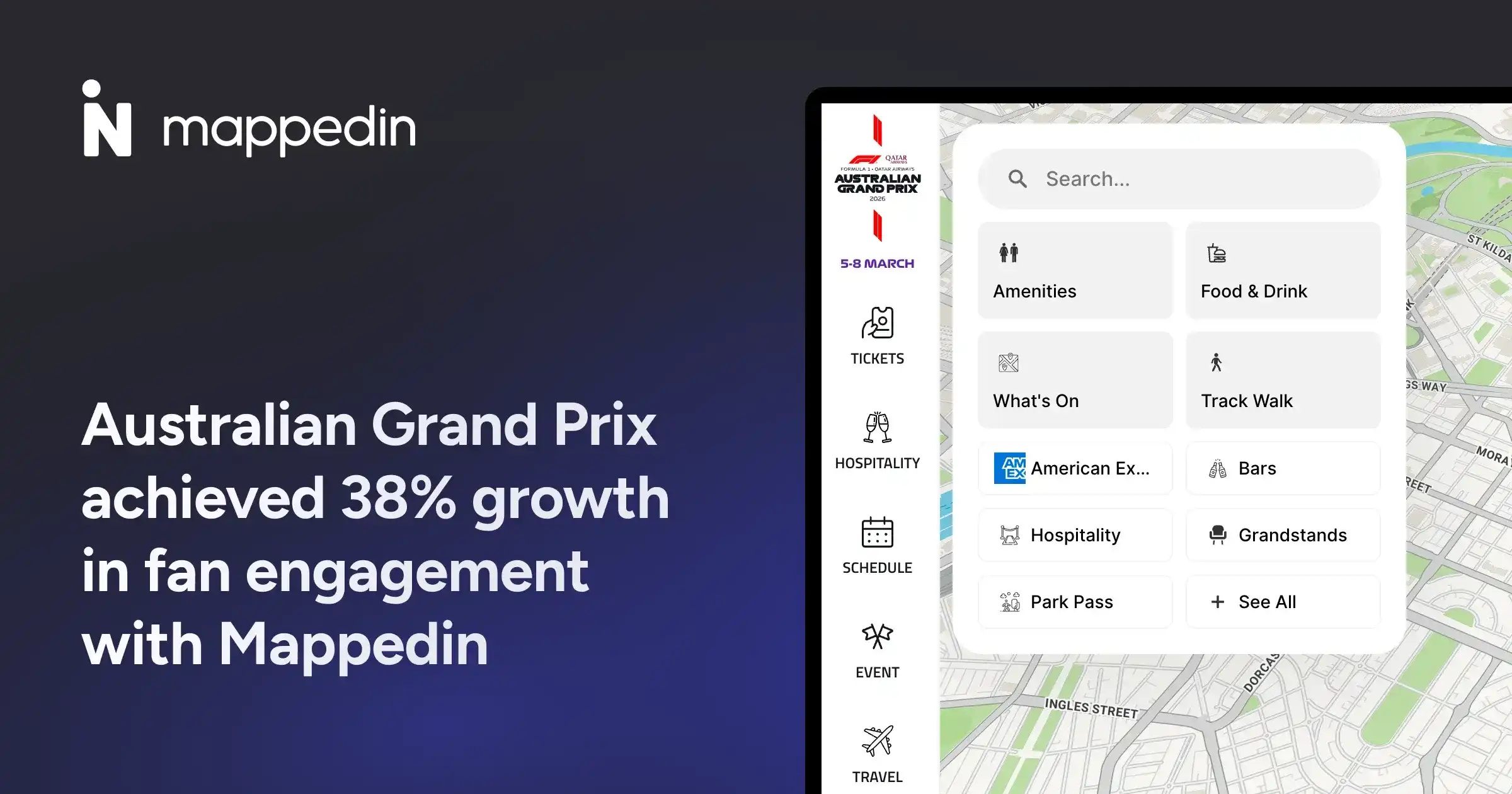
A first-time fan still searching for their section at kickoff isn't looking to buy a hot dog or a jersey. Lost time is lost revenue, and knowing what fans need and when they need it is core to a frictionless gameday experience.
Fan Experience teams use Mappedin to move fans from parking to seat without friction, then turn the minutes they save into concession, merch and sponsor revenue. Smoother, smarter navigation with built-in discovery pays for itself.
Stadium teams using Mappedin to power gameday fan experience and back-of-house operations and maintenance help fans find seats, concessions, and exits faster while boosting revenue and fan satisfaction.
Key takeaways at a glance
- The map is a revenue channel, not just a navigation tool. At St. Louis CITY SC, featuring new food partners on the interactive stadium map contributed to up to 150% higher sales than previous partners in the same locations.
- A seamless experience and revenue are the same job. Every minute a fan isn't lost is a minute they can spend in the concourse.
- One map, every channel, every event. Keep web, app, directory and signage accurate across games, concerts and everything in between, and let your own team make the edits.
- The advantage comes from what the map knows. When routing, concessions, sponsors, accessibility and analytics share one map, a fan's route to their seat can pass an activation, avoid a broken elevator and be measured.
Looking for an indoor mapping solution to power stadium wayfinding, simplify operations, and improve fan engagement? Book a custom demo of Mappedin →
8 ways Fan Experience teams use Mappedin
Each use case below starts with the challenge stadium teams face on gameday, then shows what a Mappedin map changes and the outcome on both experience and revenue.
1. Turn pre-arrival anxiety into gameday confidence
For the 2026 FIFA World Cup, NRG Stadium reported that 44% of its ticket buyers were international. While the event might be less frequent than the standard American football game, the fact remains: many fans and concert goers are first-time visitors to the venue. A first-time fan doesn't know which lot, gate or end zone is theirs, and traffic backs up around the stadium before anyone even enters.
Mappedin lets fans plan before they arrive:
- Deep links and embeds put map previews inside ticket emails and on the team website making maps easy to find on game day
- RealView previews of the venue and routing to transit, shuttles and parking by category allow fans to get a look inside stadiums and plan their route and transportation
- Map Editor lets teams manage road and lot segments for traffic flow, making game day updates or safety diversions in real-time
The win is fewer lost first-timers and better use of premium parking and team-subsidized transit.
2. Get every fan from parking lot to seat
Stadiums aren’t always easy to navigate. They’re often multi-building, indoor-outdoor venues, not to mention the offsite parking and transit fans and staff have to tackle before entering the building.
Outdoor-to-indoor routing handles the gap most maps ignore. Fans find and save their parking spot, get routed from the lot or entry gate, and follow continuous blue dot positioning through concourses and elevators all the way to section, row and seat. One map spans the outside world and the indoors without handing the journey off to a second tool.
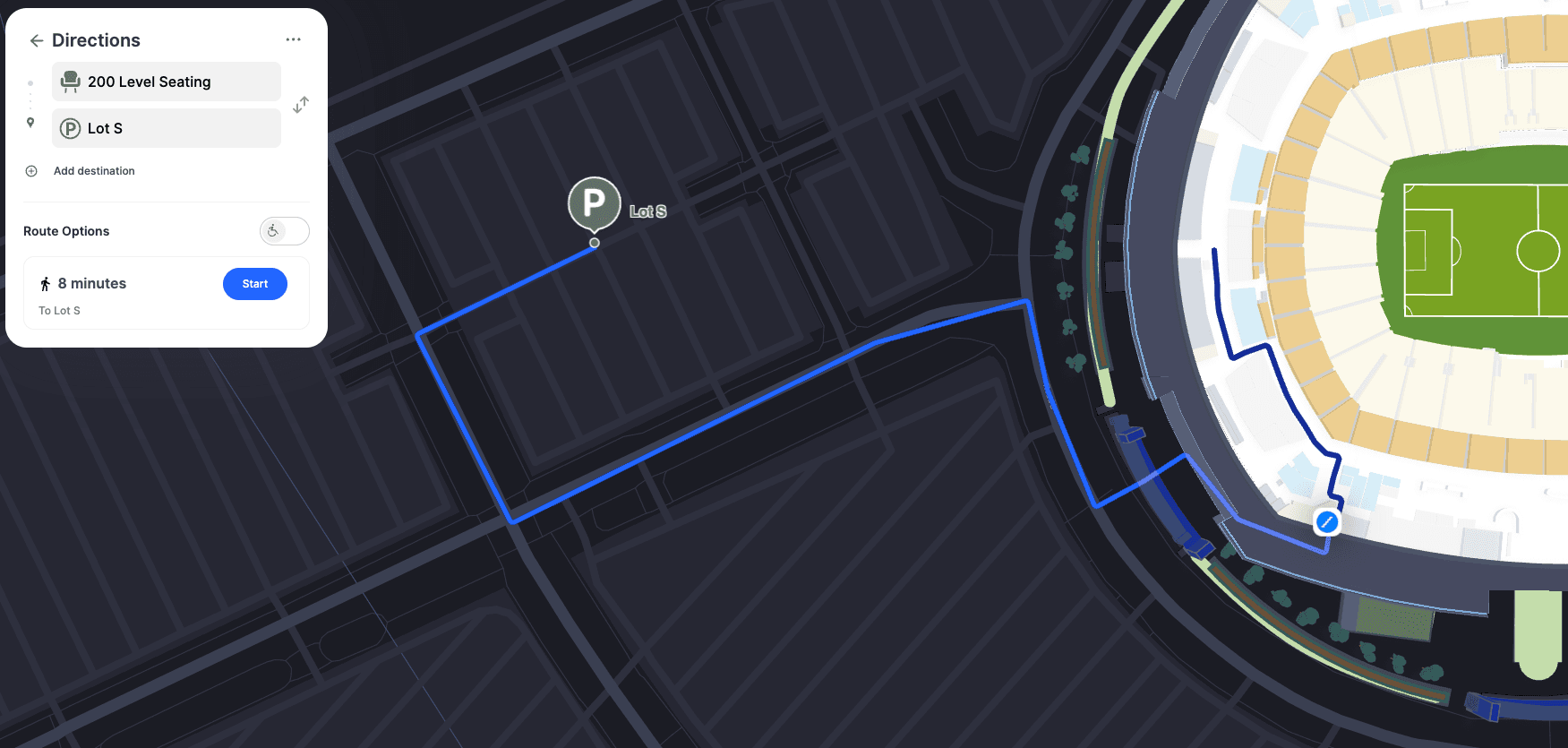
The result is faster first-pass arrival and higher NPS, plus more time in the concourse before the game starts.
— Kenton Olson, VP of Digital & Emerging Media, Lumen Field
3. Route fans to food and merch in the windows that matter
Halftime is only so long, and a fan has a checklist to accomplish in that block: restroom break, grab a snack, hit the fan store, and find their way back to their seat when they’re done.
Search, discovery and routing solve it together. Fans search by specific category or dietary need, find featured partner locations with full profiles, and get turn-by-turn directions to concessions and merch.
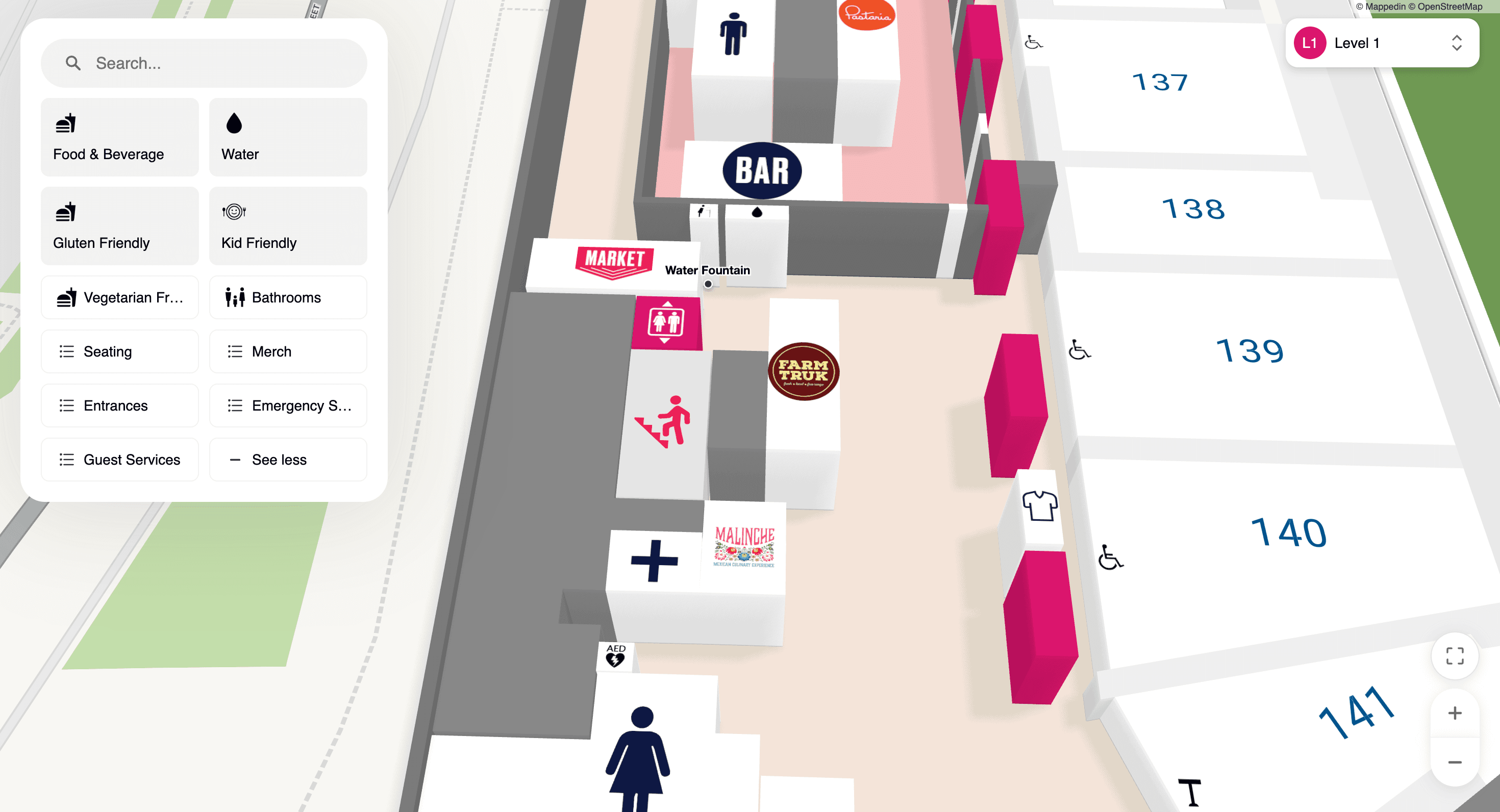
Changing concession details is fast and easy and can be done in the Editor, so food content stays current without a vendor call. Wait-time display is available as a custom integration for teams that want it.
At St. Louis CITY SC, featured food partners on the interactive stadium map contributed to up to 150% higher sales than previous partners in the same locations. Fans find what they want faster, and per-cap spend follows.
— Aaron Brewer, Senior Product Manager, St. Louis CITY SC
4. Drive measurable foot traffic to sponsor activations
Proving value to sponsors is essential to secure contract renewals and justify spend.
Sponsor and activation points of interest get the same location profiles and step-by-step routing as concessions, so fans can find and reach an activation in a concourse they'd otherwise miss. AT&T Stadium and a major motorsports venue all put activations on the map this way.
Mappedin gives stadium partnership teams concrete navigation and intent metrics to prove sponsor impressions, justify sponsorship costs, and secure high-value contract renewals.

5. Personalize and energize the gameday for every fan
A family, a lifelong fan and a premium ticket holder usually enter the stadium with the same generic map, leading to a less than personalized experience that causes confusion and frustration.
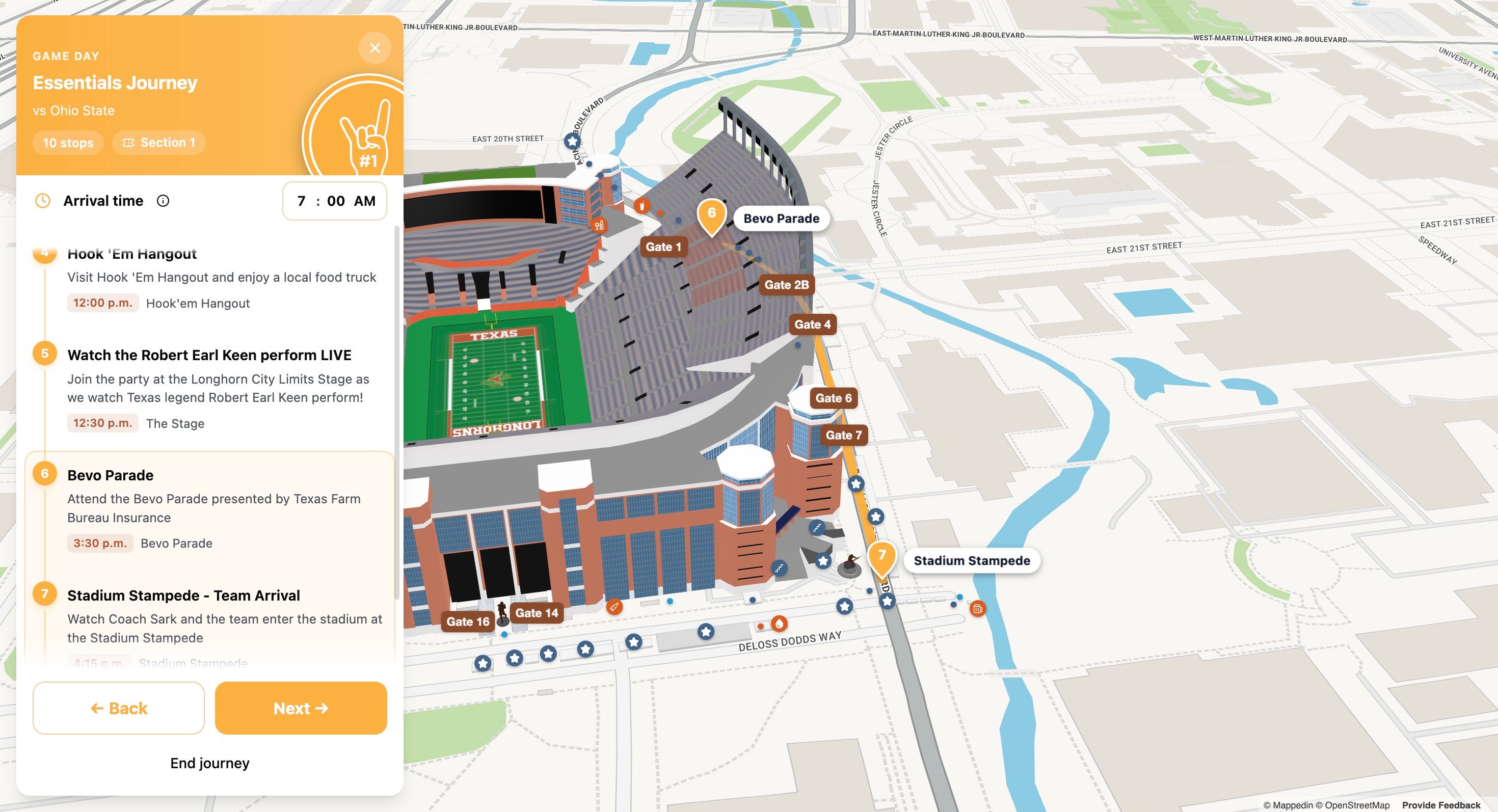
Mappedin’s Fan Journeys let teams build multi-stop routes by preference, whether that's family-friendly activities or craft beer stops. Premium entitlement filters show the gates, elevators, lounges and concessions a premium ticket includes, and real-time content such as live scores sits inside the map itself.
The University of Texas at Austin uses Fan Journeys to help fans discover more of the stadium:
— Drew Martin, Deputy Athletics Director
The outcome is a better premium experience and higher NPS, with fans exploring more of the venue and spending along the way.
6. Keep one accurate map across every channel and event
Stadiums and arenas host more than that season’s home games. They are home to concerts, fundraisers, international games, festivals and more. Stadium operators need a tool that seamlessly switches from the gameday view to concert view in minutes, not weeks.
Mappedin is a single source of truth for the stadium experience. The same map publishes to web, mobile app, directories and digital or physical signage, with Mappedin Directory as a live, always-current channel.
The Map Editor lets your own team make changeovers between events and tenants branding, gates, flow and concessions, with no third party required.
This is where multi-tenant venues feel it most. Mappedin is used across world-class sports venues to power their experience, gameday and beyond, swapping the venue layout seamlessly off the core map based on the day’s event. For example, the map is ready to support a concert on Friday night and then a football game on Sunday afternoon.
Fans never get conflicting information, and dev and vendor costs drop because edits happen in-house.
7. Make every route work for every fan
A fan in a wheelchair or a parent with a stroller should have the same welcoming, inclusive experience as any other fan. At the same time, elevators break down, stairways are closed off for maintenance, and teams need to guide fans with alternate routes the moment they need them.
That’s why Mappedin builds in accessibility. Step-free routes avoid stairs and escalators and send fans to elevators and ramps. Accessible zones are marked on the map, and the directory interface adjusts for fans who need a different reach or view.
Accessibility is engineered directly into the Mappedin platform. Independently audited against WCAG 2.2 Level A and AA standards, our software delivers inclusive, real-world venue navigation for every guest while supporting global ADA, AODA, and EAA compliance.
The payoff is fewer incidents and more independence for fans with mobility needs, and more fans able to attend, move around and spend with confidence.
8. Measure and act on fan engagement data
Updates to a stadium’s digital fan experience are impactful, but how can teams prove success to leadership?
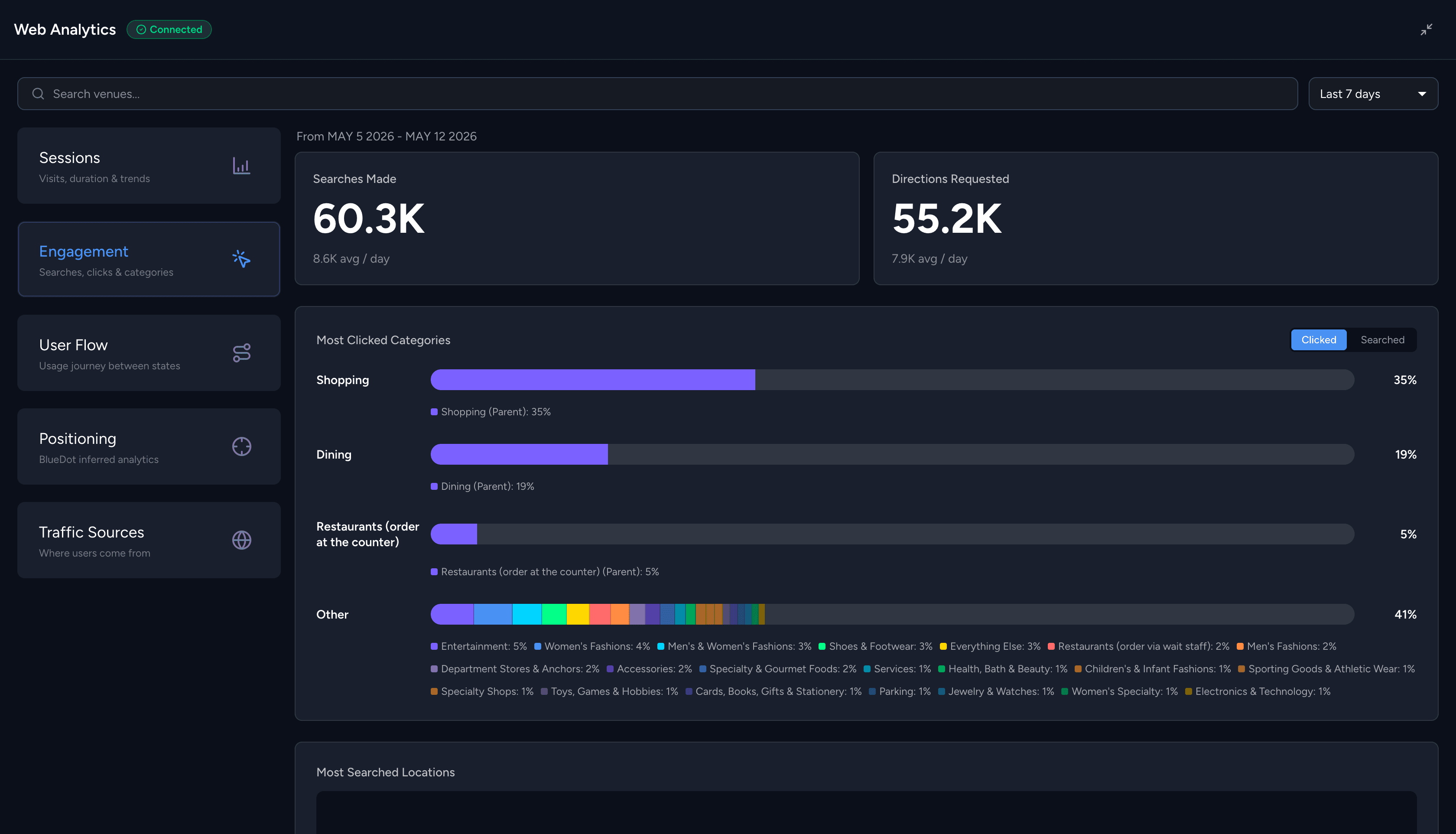
Mappedin’s web, directory and conversational analytics show what fans search for, where they route to and what they can't find. The mobile SDK brings wayfinding and analytics into the team's own fan app, and an in-map feedback button captures feedback at the moment it happens.
— Spencer Furgerson, Digital Product Coordinator, Lumen Field
The win is operational: find the spots where fans get lost and fix them before the next event, and treat searches that return nothing as demand for new food, merch or activations.
Why stadiums choose Mappedin for fan experience
Many venues run separate vendors for the app map, directories, parking, sponsor content and accessibility. Each has its own data, and they drift out of sync, so the app, the directory and the sign say different things.
With Mappedin, routing, points of interest, featured partners, sponsor activations, accessibility and analytics all live on one indoor-native map, and it lets teams build fan experiences on top of it.
Implementing Mappedin before the next gameday
Treat launch as a checklist, not a big bang.
- Decide who owns map edits (Digital, Guest Experience or Ops) and who approves changes on event days.
- Build a map layout template for each event type, from NFL to concert, so changeovers follow a routine.
- Choose where the map goes live: website, ticket emails, fan app via the SDK, directories and signage.
- Load the concessions with menu and dietary details, plus sponsor activations, premium areas and accessible routes.
- Decide which food and sponsor partners get featured placement and how you'll report results back to them.
- Set KPI baselines for NPS and CSAT, first-pass arrival time, per-cap spend, concession sales by location and activation foot traffic, so you can show the lift later.
A smoother gameday and stronger revenue
A frictionless fan journey and gameday revenue are actually parts of the same whole, and one indoor-native map is the lever that connects them. Increased revenue and improved fan satisfaction are what happens when discovery, routing and featured placement live on a single map instead of drifting across vendors.
Mappedin is the nervous system of your stadium. A venue is a living system where routing, sponsors, accessibility and analytics respond to every fan in real time. The operators who treat it that way keep the advantage, because they can measure and improve the gameday instead of guessing at it.


Share