Miami International Airport
Navigate MIA's 130-plus gates, concourses, and services with ease.


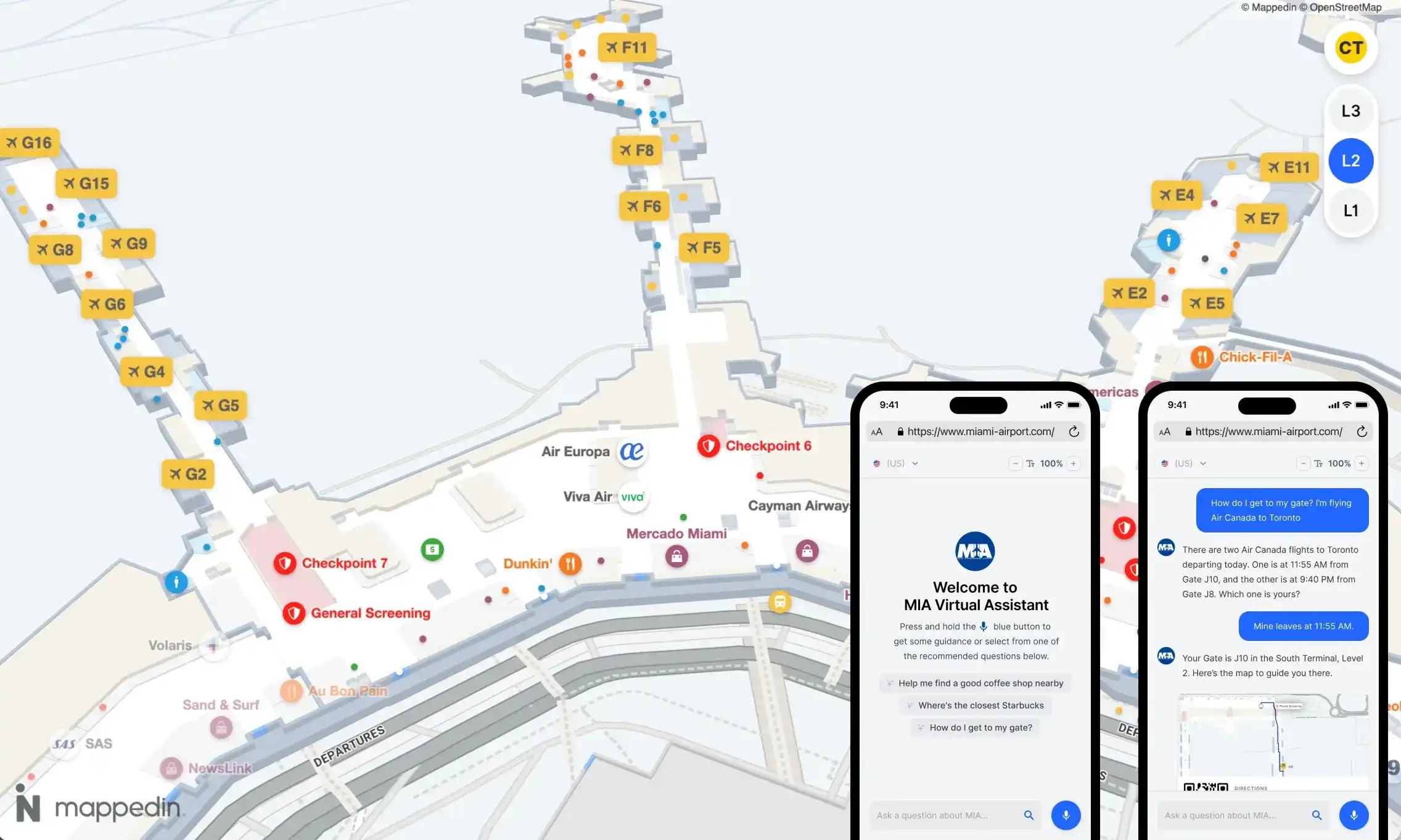
Explore Miami International Airport including every concourse, gate, terminal level, and passenger service point. Pan and zoom to find your gate, locate the nearest restroom or lounge, or trace the connection path between concourses.
About Miami International Airport
Miami International Airport traces its origins to 1928, when it opened as Pan American Field. Nearly a century later, MIA has grown into one of the most strategically significant airports in the Western Hemisphere. Spanning over 3,200 acres in Miami-Dade County, the airport's terminal complex encompasses more than 130 gates spread across multiple lettered concourses, served by four runways, the longest of which stretches up to 13,000 feet.
In 2025, MIA welcomed 55.3 million passengers through its doors, cementing its position as the second-busiest airport in the United States for international travelers. That international volume makes MIA's terminal one of the most multilingual, multi-itinerary environments in U.S. aviation. Passengers routinely navigate tight connections across concourses that span significant distances, often while managing language barriers and unfamiliar terminal layouts.
To meet that challenge, MIA has made a major commitment to modernizing its digital passenger experience. In 2026, Miami deployed an industry-first navigational tool: the MIA Virtual Assistant, the aviation industry's first large-scale deployment of geo-aware, agentic AI.
Powered by Mappedin with Satisfi Labs and Hypervsn, the assistant delivers real-time, location-aware answers in multiple languages, accessible via web, WhatsApp, and holographic avatar terminals placed within the concourses. Real-time operational data, normalized by Radiant Technology, keeps the system accurate as gate assignments, vendor hours, and terminal conditions change by the minute.
Why interactive wayfinding matters here
An airport handling more than 50 million passengers a year (a large share of them being international travelers navigating an unfamiliar terminal in a second language) can't rely on static signage alone.
When a gate changes, a concourse closes, or a connection time shrinks, printed maps and fixed directories become liabilities. MIA's investment in a geo-aware, AI-powered interactive map reflects what modern airport ops teams already know: real-time digital wayfinding reduces missed connections, cuts staff intervention at information points, and measurably improves the passenger experience at scale. That's the infrastructure layer Mappedin provides.
Details
- Miami International Airport
- Miami, FL
- Miami International Airport Website