

More than 85% of patients ask for directions when visiting a hospital or public health facility. Nearly a third of first-time visitors get lost entirely.
Most health system leaders see this in in patient complaints and in front desk staff and volunteers fielding the same directional questions. What's less visible is what the friction truly costs.
Navigation failures are a financial and operational problem that shows up in no-show revenue, Medicare reimbursement, clinical staff productivity, and patient satisfaction scores. For most health systems, it's a problem that a legacy combination of printed maps, static kiosks, and well-intentioned volunteers has never been equipped to solve.
In this blog, we cover what health system leaders need to know when evaluating a modern hospital wayfinding system:
- What the problem is actually costing
- Where legacy approaches break down
- What to look for in a platform
- How to build the internal case for investment
For leaders who want to future-proof their healthcare campus and patient experience, this guide will get you started.


Unlock better patient experience with interactive wayfinding
For most patients, the care experience doesn't begin in the exam room. It begins in the parking garage, at a lobby directory, or on a phone screen. This guide gives Patient Experience leaders a practical framework for turning wayfinding from a persistent pain point into a coordinated, measurable program.
The real cost of hospital navigation failures
The full cost of wayfinding failure runs across three key areas that rarely get connected.
No-shows and late arrivals
The average hospital no-show rate is 18%, with rates ranging from 5% to 30% depending on specialty. Not all of those missed appointments are attributable to navigation. But research consistently identifies navigation confusion as a top barrier at complex, multi-building campuses, particularly for first-time specialty patients who have no prior familiarity with the facility layout.
For a 500-bed health system running more than 750,000 appointments per year, even a modest reduction in navigation-driven no-shows and late arrivals translates to hundreds of thousands of dollars in recovered appointment revenue annually.
Staff burden
The staff cost of wayfinding problems extends beyond the dramatic moments when a patient misses a time-sensitive scan.
Across a large health system, that's a meaningful diversion of clinical and operational capacity.
More troubling: nearly 44% of staff in that same study reported experiencing incivility from visitors who had become frustrated by navigation failures. Wayfinding confusion creates friction that affects the people delivering care.
HCAHPS and VBP exposure
The reimbursement dimension is the one most Digital Experience leaders can take directly to a CFO. Navigation-related complaints consistently appear in post-visit survey data and patient advocacy reports, yet most health systems have no digital solution deployed to address them.
For a 500-bed health system, $400K–$800K in HCAHPS-linked Value-Based Purchasing reimbursement is at risk annually. Improvements to three HCAHPS composites are all directly influenced by whether patients arrive oriented and on time, or stressed and late:
- Overall hospital rating
- Willingness to recommend
- Staff responsiveness


Why most hospital wayfinding systems fail
The instinct when wayfinding complaints increase is to commission a signage refresh: new colors, updated fonts, clearer arrow placement. It's a reasonable instinct that almost always produces limited results.
The underlying problem is that most hospital campuses weren't built as unified environments; instead, they accumulated over decades. For example, a surgical wing added decades ago carries one signage system, while a lobby renovation in the last five years brought digital screens and updated branding.

Each layer was installed thoughtfully, but no one designed them to work together. The result is what designers call accumulated signage debt: a system where individual components are locally coherent but globally confusing.
The highest-friction moments in a patient's journey typically happen at the junctions between eras, e.g. the connector corridor between the old tower and the new pavilion, the parking garage exit that pre-dates the building it now leads to.
Static printed maps and legacy kiosk systems compound this problem because they can't update in real time. When a department moves, construction reroutes a corridor, or a wing gets renamed, the physical signage lags by weeks or months. Patients follow directions that were accurate six months ago to destinations that have moved.
The real problem with hospital wayfinding is spatial, not visual. Read why hospital wayfinding design fails (and how to fix it) →
What to look for in a hospital wayfinding system
When evaluating hospital wayfinding systems, health system leaders should prioritize outdoor-to-indoor navigation continuity, EHR and patient portal integration, real-time map update capability (without vendor intervention), multi-building campus support, WCAG/ADA compliance across all surfaces, and a deployment timeline under 60 days. The right platform serves patients, clinical staff, facilities teams, and IT from a single living map layer, not a collection of siloed tools.
Here's what each of those criteria means in practice.
Outdoor-to-indoor navigation continuity
A patient's navigation experience should begin before they arrive on campus via their appointment reminder or patient portal, and run seamlessly from the parking structure to the exam room door. Any system that requires a patient to switch apps or re-enter a destination at the building entrance introduces the friction it was meant to eliminate.
EHR and patient portal integration
Connection to Epic MyChart, Cerner/Oracle scheduling, or appointment reminder workflows allows navigation to be delivered as part of the pre-visit communication patients already receive. This is the single highest-leverage touchpoint for reducing late arrivals: the patient has directions before they're lost, not after.
Real-time map updates
Evaluate who owns the map and how quickly it can change. A system that requires filing a vendor ticket to rename a department or reroute around a construction zone will always be outdated. The right answer is that someone on your facilities or IT team can make a change and see it reflected across all surfaces (i.e., mobile, web, kiosk, QR code) in minutes.
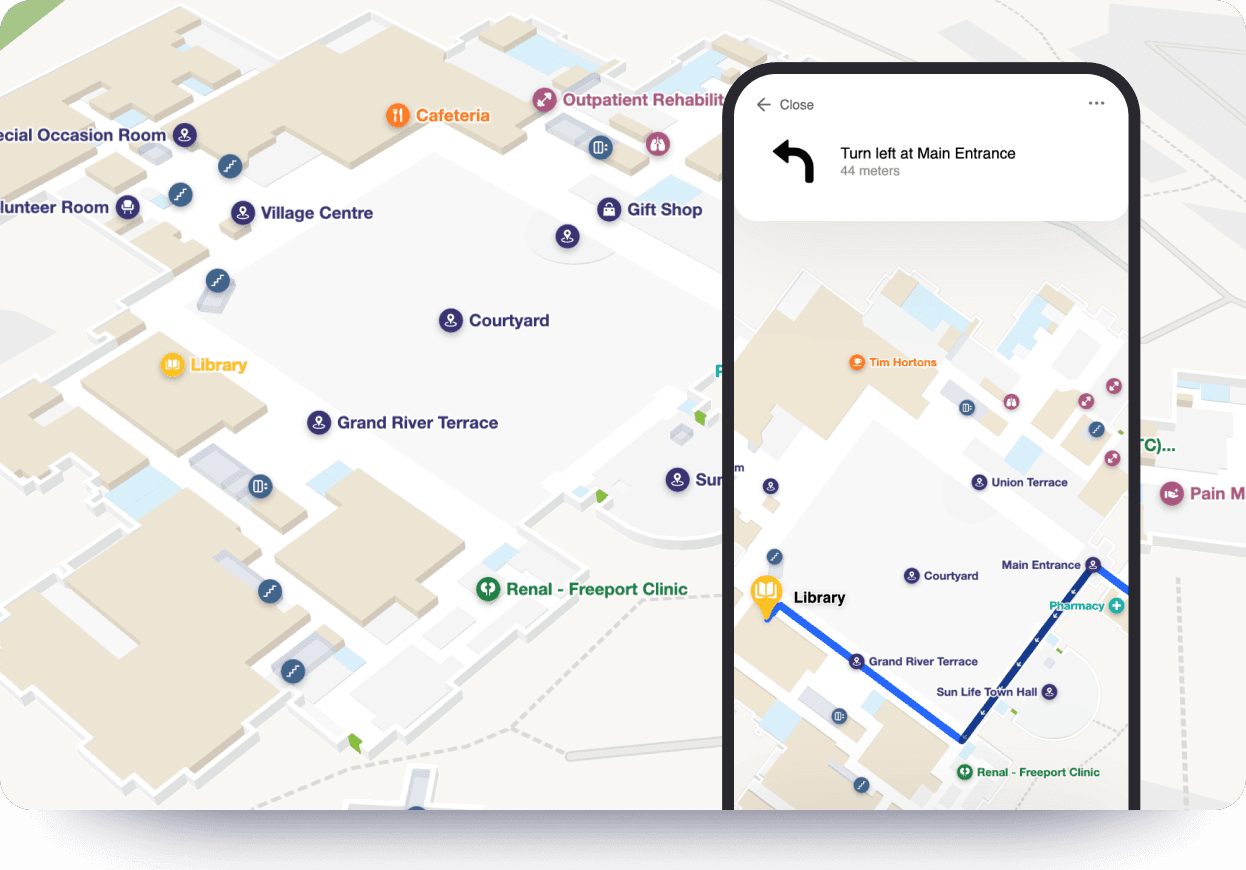
Multi-floor, multi-building campus support
Health system campuses have grown through acquisition and expansion. A platform should unify disparate buildings, towers, and generations of construction into a single routing experience, not treat each building as a separate deployment with its own map.
WCAG/ADA compliance and multi-language support
Hospitals serve some of the most diverse patient populations of any indoor venue. WCAG 2.1 AA compliance, wheelchair-accessible routing options, screen reader compatibility, and 40–50+ languages across all surfaces should be baseline requirements, not premium add-ons. Critically, these should apply from a single configuration, not require separate setups for each channel.
Deployment speed
Building an indoor mapping system internally costs $1M–$3M and typically takes 12–18 months. Evaluate whether a platform provider can get your campus to live, patient-facing navigation in 30–60 days.


Why hospital maps matter, beyond navigation
The easiest way to stall a wayfinding investment is to frame it as a patient experience project. The most effective way to move it forward is to show its value across multiple departments simultaneously.
For IT and the CIO
A modern wayfinding platform is a consolidation play. Most health systems are currently running separate tools for RTLS asset tracking, a wayfinding or kiosk app, printed map management, and digital signage content, often from different vendors, with no shared data layer.
Collapsing those into a single API-connected map layer that serves RTLS, CMMS, EHR portal, security, and facilities ops can eliminate hundreds of thousands of dollars per year in duplicated vendor licensing.
For facilities and plant operations
When a department moves or a floor plan changes, a dynamic map platform updates all surfaces simultaneously — mobile, web, kiosk, and emergency operations documentation. That's the difference between a map that's current and one that's actively confusing patients every day a reprint cycle runs behind.
For biomedical and clinical engineering
RTLS integration overlaid on the live map enables visual asset tracking. Audit documentation becomes straightforward when location records are tied to a live, accurate spatial layer.
A single map layer that serves navigation, facilities operations, asset tracking, and security is a fundamentally different budget conversation than a patient wayfinding app, but instead, necessary digital infrastructure.
Get a full breakdown of system components, implementation phases, and what a successful deployment looks like in practice. Read How to implement a hospital wayfinding system →
Compliance & accessibility: The non-negotiables of hospital wayfinding systems
Accessibility in hospital wayfinding is both a compliance requirement and a patient equity imperative. The following are baseline expectations. A credible platform should deliver:
- WCAG 2.1 AA compliance across all channels
- Step-free routing
- Screen reader compatibility
- High-contrast visual modes
- Navigation in multiple languages (without separate per-language configuration)
Accessibility settings should apply simultaneously across web, mobile, and kiosk from a single deployment.
What a strong hospital wayfinding system looks like in practice
What "good" looks like for healthcare wayfinding should be tied to real, measurable changes in how patients, visitors, and staff experience the building every day.
Patient navigation
A modern hospital wayfinding system begins working before the patient even arrives. A navigation link delivered through an appointment reminder or patient portal routes the patient from their starting point to the specific clinic, floor, and entrance they need, with accessible path options available by default.
On campus, that same guidance continues unbroken through the parking structure and into the building, surfaced on their phone or handed off to a lobby kiosk. The patient arrives oriented, on time, and without having asked anyone for directions. A frictionless arrival sets the tone for everything that follows, and it shows up in how patients rate their overall experience when the post-visit survey arrives.
Staff wayfinding & efficiency
The benefits of a well-implemented wayfinding system don't stop at the patient entrance. Staff navigate the same complex environments often under time pressure, and across buildings they're less familiar with.
Every directional question a nurse, volunteer, or security guard fields is time diverted from their primary work. A system that solves patient navigation reduces front-desk interruptions across every access point, freeing clinical staff to focus on care.
Mobile equipment location
For facilities and biomedical teams, a wayfinding platform integrated with RTLS data provides a real-time visual layer for locating wheelchairs, IV poles, and crash carts across floors and buildings. Staff locate equipment in seconds rather than searching manually, reducing both the time cost and the frustration that comes with it.
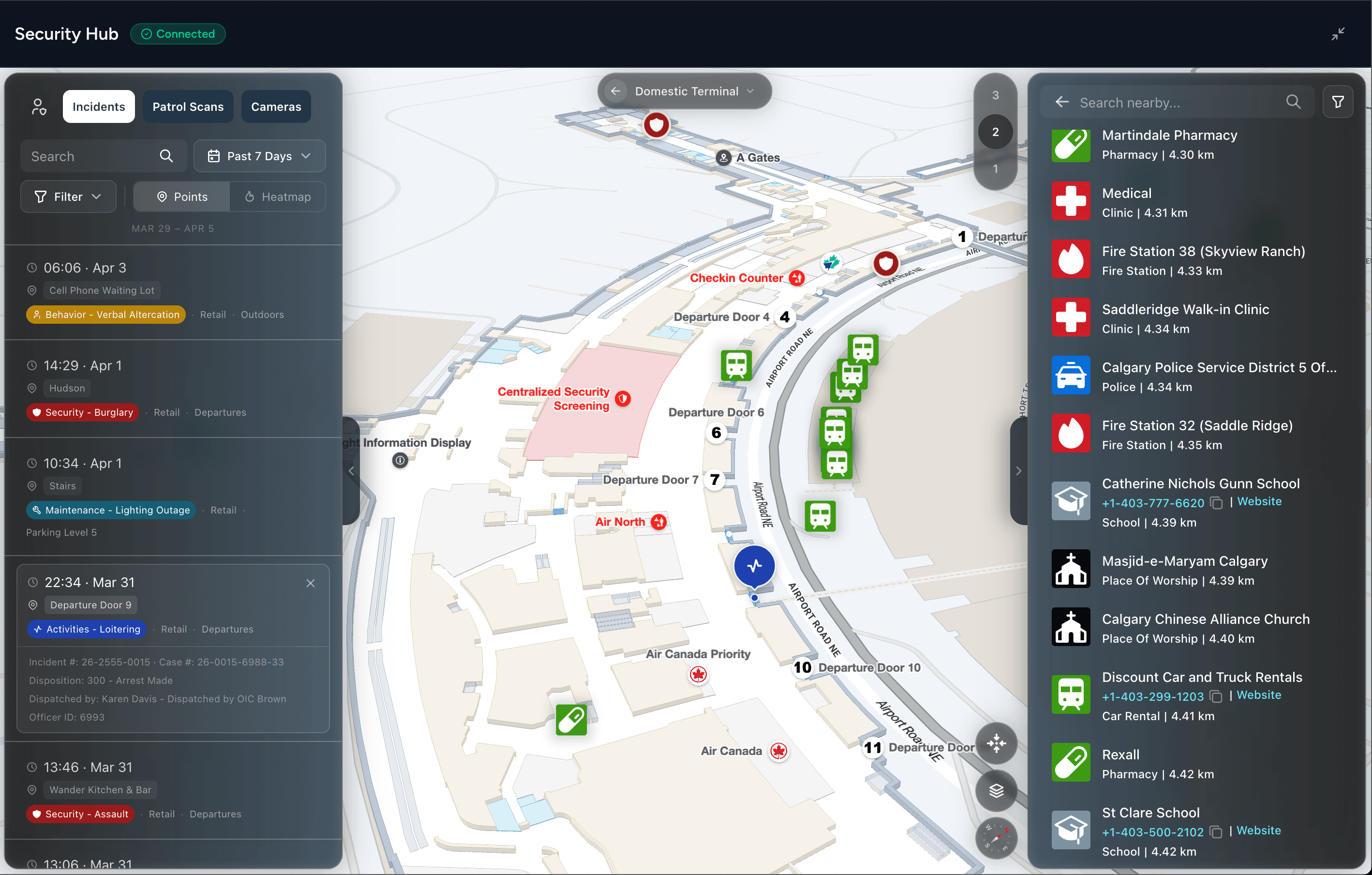
Emergency routing and hospital security
The same spatial layer that guides patients to their appointment can route staff and security teams during an emergency, pushing real-time evacuation paths and location-aware alerts across every device on the network. A unified map is both a navigation tool and an operational safety asset.
Why hospital mapping is a strategic priority
Hospital mapping is so much more than a digital amenity. It's a revenue and reimbursement lever that operates before the clinical encounter begins.
The patients who arrive on time, who navigate without friction, who recommend the health system to others: their experience starts before any nurse or physician has spoken to them. Getting that experience right doesn't require overhauling your facility. It requires treating the physical campus like the digital asset it already is: one that can be mapped accurately, updated in real time, and made navigable for every patient regardless of ability or language.
For health system leaders ready to move from evaluation to implementation, the starting point is understanding your specific campus footprint, your existing portal and EHR infrastructure, and where your current wayfinding system is costing you most.
Related resources:


Share